
Why We Built Something Lovely
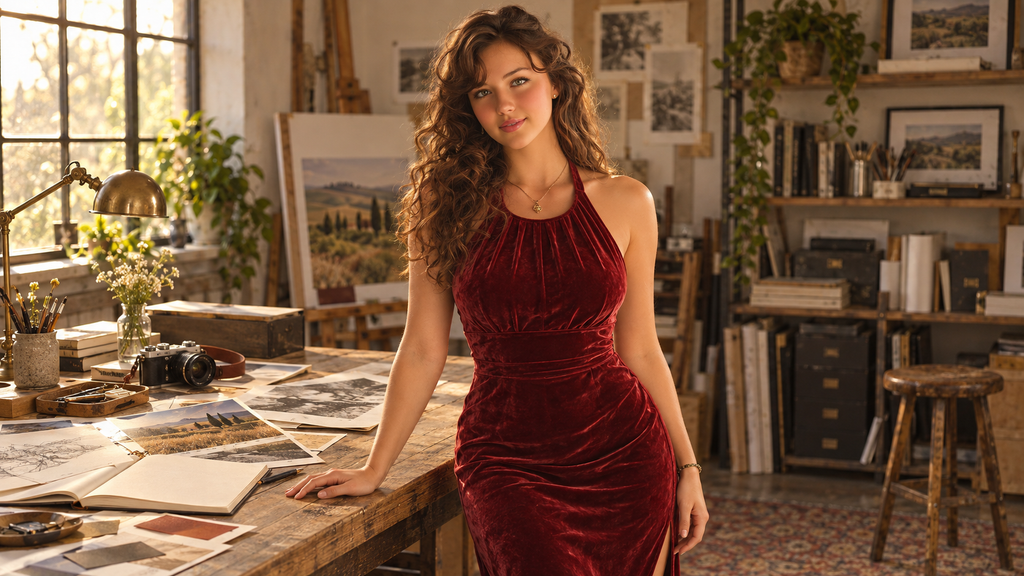
Celeste standing beside a worktable in a sunlit art studio
The internet has never suffered from a shortage of beautiful images. They appear by the thousands, pass beneath our thumbs, hold our attention for a moment, and disappear into the endless current behind them.
Something Lovely began with a simple question: What would happen if we asked those images to mean a little more?
Not every picture needs a plot. Beauty can be worthwhile for its own sake. A striking face, a quiet room, late-afternoon sunlight, or an unexpected expression can create a perfectly complete moment. But when images are connected—when the woman in the frame has a name, a personality, a home, unfinished work on her table, and somewhere she intends to go next—they can become something richer.
They begin to suggest a life.
That is the idea at the center of Something Lovely: beautiful women living memorable lives.
More Than a Stream of Pretty Pictures
Something Lovely first took shape as a social-media project. At its simplest, it was a place to share images that were attractive, atmospheric, and capable of making someone stop scrolling.
That remains part of what we do. We are not embarrassed by beauty, and we do not believe every image needs to carry a solemn message to justify its existence. Sometimes a photograph should be playful. Sometimes it should be romantic, intimate, funny, glamorous, strange, or simply lovely.
But isolated images have limitations. Social media encourages everything to be consumed quickly and forgotten just as quickly. A picture may reach thousands of people, yet almost nobody sees what came before it or what follows. Characters become interchangeable. Locations become backdrops. Every moment is separated from the larger world that might have given it meaning.
We wanted to build something with more permanence.
On Something Lovely, images are arranged into galleries that unfold as experiences rather than disconnected posts. A woman may begin her morning in the kitchen, carry her coffee onto the porch, wander into the garden, lose track of time, and return indoors just before the rain. Another gallery might follow an artist from her cluttered studio into the woods as she searches for something worth photographing and eventually sketching. A third might capture only an hour beside a swimming hole—but allow that hour to breathe.
These are modest events. That is intentional.
Most lives are not composed entirely of dramatic turning points. They are made from small decisions, familiar rituals, private jokes, unfinished projects, impulsive detours, and quiet moments no one else sees. Those details are often what make a character feel real.
The goal is not merely to produce an attractive woman in an attractive setting. It is to create the impression that she was doing something before the camera arrived—and that she will continue living after it leaves.
Building Worlds Around People
Every Something Lovely character begins with more than an appearance.
We think about where she lives, what she does, what she enjoys, what irritates her, what she keeps within reach, and what she might do when nobody is watching. We consider the clothes she would actually own, the objects that belong in her home, and the difference between how she presents herself and how she looks during an ordinary afternoon.
Those decisions shape the images.
A multimedia artist should not inhabit a spotless studio decorated with generic art supplies. Her space should contain evidence of work: stained brushes, half-used tubes of paint, abandoned sketches, tools left where she last needed them, and perhaps a project that has occupied the same corner for months. An off-grid fantasy author should not simply pose beside a rustic cabin. Her home, garden, manuscript, clothing, and routines should feel like parts of the same existence.
Even small details matter. If a coffee mug is left on a porch table, it should still be there when the character returns. If her hair becomes damp in the rain, it should not be perfectly dry in the next moment. If she changes clothes, there should be a reason—or at least enough passing time for the change to make sense.
Visual continuity is imperfect, particularly when working with emerging creative technology. But pursuing it changes the entire process. It forces us to think beyond individual images and consider sequence, environment, character, and cause and effect.
In other words, it turns picture-making into storytelling.
A New Kind of Creative Process
Something Lovely uses generative artificial intelligence as part of its creative process. We believe in being clear about that.
The people appearing in our original galleries are synthetic performers. They are created characters rather than photographs of real models, and the scenes surrounding them are constructed through a combination of concept development, writing, image generation, selection, editing, sequencing, and design.
The word generated can make the process sound instantaneous: type a sentence, press a button, and accept whatever appears. That is not how Something Lovely is made.
A finished gallery may begin with dozens—or hundreds—of discarded attempts. Faces drift. Rooms change shape, clothing mutates, important objects disappear, and seemingly simple actions fail in surprising ways. Sometimes an image is technically impressive but wrong for the character. Sometimes it is beautiful but breaks the sequence. Sometimes everything appears correct except for the one detail that makes the entire scene unusable.
The work lies in making choices.
It means developing the character before creating the images. It means designing a sequence with movement and variety. It means recognizing when a result fits the larger story and when it merely looks good in isolation. It means revising prompts, correcting inconsistencies, editing final selections, writing accompanying text, and arranging everything so that the gallery feels intentional.
Artificial intelligence makes these imaginary people and places possible, but it does not decide why they should exist or what they should become. The tools provide possibilities. Human judgment gives those possibilities direction.
We use the term AI-assisted photography because it describes both the visual language and the collaborative nature of the process. The finished work borrows from portraiture, fashion photography, documentary photography, cinema, illustration, and narrative fiction. It is not traditional photography, but it is deeply informed by the way photography frames people, preserves moments, and invites viewers to wonder what exists beyond the edges of an image.
This is a young medium. Its conventions have not been settled, and much of its creative territory remains unexplored. That uncertainty is part of what makes it interesting.
Why Give the Characters Stories?
A character does not need a detailed biography for someone to enjoy her picture. But even a little context changes the way we look.
A woman standing beside a highway is one image. A woman driving west with nearly everything she owns in the back of her car is another. Once we know where she has been—or what she hopes to find—we begin noticing different things. Her expression matters more. So does the weather, the landscape, the condition of the car, and whatever she chose to bring with her.
Narrative creates attention.
It can also create affection. When a character returns across multiple galleries, she becomes familiar. Viewers recognize her home, habits, temperament, and relationships. They are not simply looking at another attractive stranger. They are visiting someone whose world they have entered before.
That is why Something Lovely includes both Galleries and Stories.
The Galleries provide the visual experience. They capture gestures, places, moods, routines, and fragments of life. The Stories allow those lives to extend beyond what can be shown in a sequence of images. They give the characters histories, desires, mistakes, conversations, and consequences.
The Journal—the section you are reading now—serves a different purpose. This is where we step outside those fictional worlds and discuss the real creative work behind them: what succeeds, what fails, how projects are developed, how physical products are made, and what we are learning as the technology evolves.
Together, these sections allow Something Lovely to be more than any one format.
Making Digital Work Physical
We also wanted the project to escape the screen.
Digital images are extraordinarily easy to distribute, but they are also easy to lose. They disappear into feeds, hard drives, forgotten folders, and platforms that may change without warning. A physical object asks to be experienced differently.
A calendar hangs in the same room for a year. A print becomes part of someone’s home. A book or collection can be held, revisited, given away, and rediscovered long after the original social-media post has vanished from view.
Producing those objects adds another layer of creative work. Images that glow on a monitor may print too dark. Paper changes color and contrast. Cropping that works on a phone may fail completely on a wall. Printers, inks, coatings, binding methods, packaging, and shipping materials all affect the finished result.
We are learning this process by making things ourselves.
That means testing paper, comparing finishes, ruining prints, rebuilding layouts, adjusting colors, and finding practical solutions with the equipment available to us. It is slower than sending a file to a distant mass-production service, but it gives us a closer relationship with the work—and eventually gives this Journal plenty of honest successes and failures to discuss.
The store is not separate from the creative project. It is one of the ways the project becomes tangible.
What We Hope to Build
Something Lovely is still evolving. We expect it to continue changing as the characters deepen, the visual tools improve, and new forms of storytelling become possible.
But the central idea is unlikely to change.
We want to create beautiful work without treating beauty as disposable. We want recurring characters to feel recognizable rather than interchangeable. We want settings to feel inhabited. We want galleries to have beginnings, endings, and moments in between. We want fiction to add meaning without requiring every visitor to read a novel. We want physical products to feel like objects worth keeping rather than merchandise produced simply because a logo could be placed on them.
Most importantly, we want to make a place people enjoy returning to.
Something Lovely does not ask visitors to pretend its characters are real people. It asks something more interesting: to accept them as deliberately created fictional people and see whether their lives can still inspire curiosity, recognition, affection, or imagination.
A character can be fictional and still feel familiar. A place can be invented and still awaken a memory. A moment can be synthetic and still provoke a genuine human response.
That possibility is why we built Something Lovely.
And we are only beginning to discover what it can become.