
Ruthie: Just Across the River, Part 2 (25 images)
READ HER STORY
Ruthie (25)
Ruthie did not make supper.
She made pie.
I had been inside for perhaps three minutes when she set the bucket of blackberries on the kitchen table, washed her hands, and began pulling jars from the pantry.
“What are we having before pie?”
She looked over her shoulder.
“Why do you keep assuming there’s something before pie?”
“Because most people consider dessert a separate course.”
“Most people didn’t pick these today.”
“That does not make blackberries nutritionally complete.”
“They’re fruit.”
“So is ketchup.”
Ruthie pointed toward the screen door.
“You can still leave.”
She knew perfectly well I wasn’t leaving.
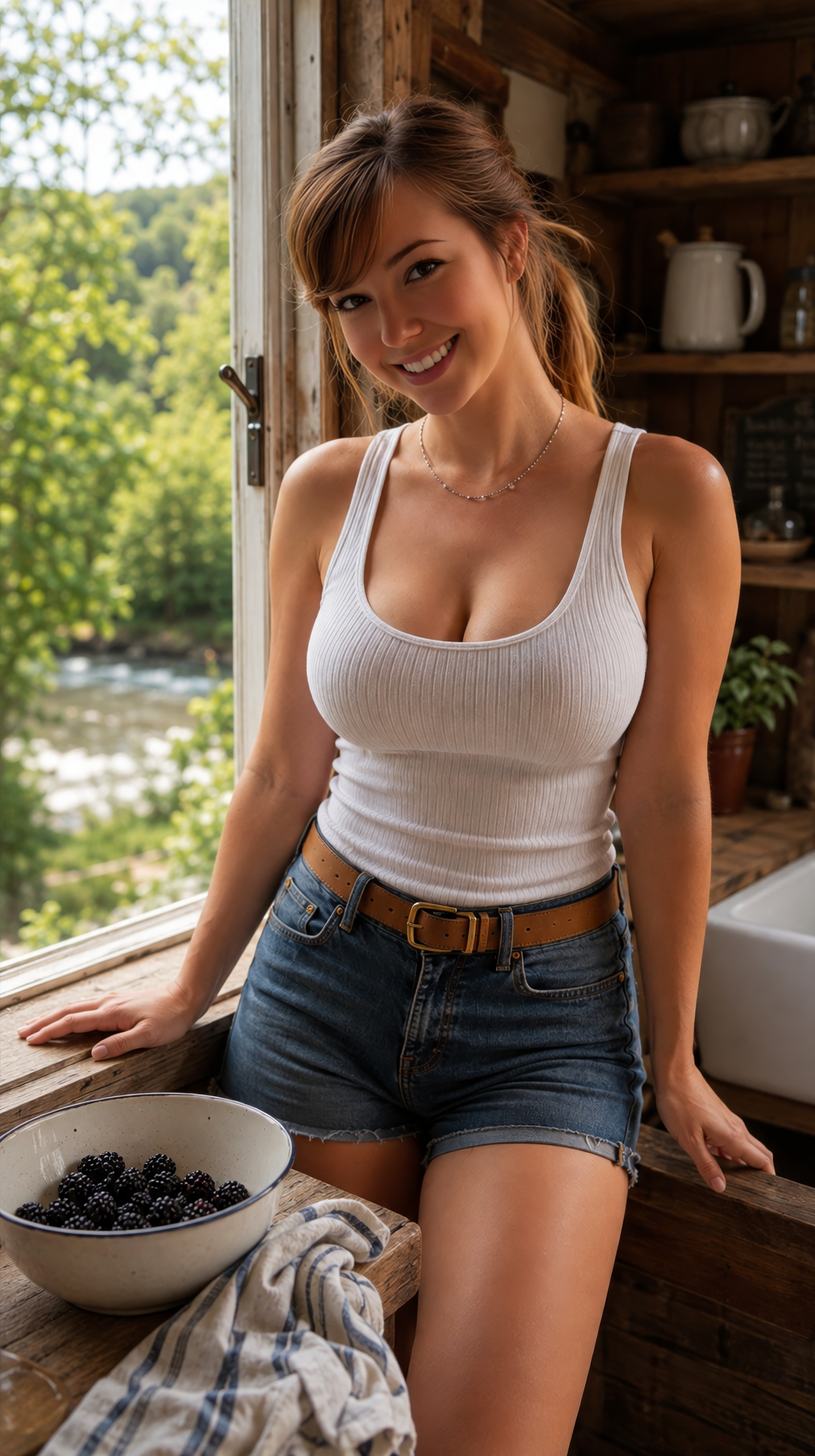
The kitchen sits at the back of the farmhouse, facing the river through two old windows that have been painted shut for longer than Ruthie has been alive. Nothing in the room quite matches. The cabinets are a faded green. The farmhouse sink is deep enough to bathe a medium-sized dog, something Ruthie confirmed had happened more than once. Open shelves hold stacks of bowls inherited from at least three different women, and the long wooden table bears a pale mark where her grandmother once set down a preserving kettle without a trivet.
Ruthie calls it damage.
Her mother calls it history.
Neither has attempted to remove it.
She changed out of her jeans before we started. The blackberry path had left mud around both cuffs, and she claimed denim shorts made more sense in the kitchen.
I looked at her bare feet.
“What happened to the decent shoes?”
“They got me back.”
“That was their entire purpose?”
“They’ve completed their assignment.”
She carried the berries to the sink and tipped them into an old enamel colander. Leaves, stems, and one tiny beetle rose among the fruit while cold water ran over everything.
Ruthie noticed the beetle.
“Found your protein.”
She lifted it carefully onto one finger and carried it outside.
That is Ruthie’s particular combination of practicality and mercy. She will flatten a mosquito against her own arm without interrupting a sentence, but a beetle discovered among blackberries receives relocation assistance.
While the berries drained, she stepped onto the porch and crouched beside several pots of herbs. Basil, mint, thyme, oregano, and something she claimed was tarragon but admitted had not tasted like tarragon in several months.
“It’s having an identity crisis,” she said.
She pinched off a basil leaf and handed it to me.
I tasted it.
“It’s basil.”
“Good.”
“Were you uncertain?”
“I wanted a second opinion.”
“You’ve been cooking with it all summer.”
“And nobody died.”
She returned to the kitchen with a handful of thyme and a few leaves of basil. The basil was for tomatoes later, which was the first evidence I received that supper might include something besides pastry. The thyme went into the blackberries.
I questioned that decision.
Ruthie stopped measuring sugar.
“You don’t trust me.”
“I trust you near rivers.”
“That sounds oddly specific.”
“I trust you with blackberries.”
“But not thyme?”
“The chutney has made me cautious.”
Her eyes narrowed.
“You’ve never eaten my chutney.”
“I’ve spoken to people who have.”
“My mother likes it.”
“Your mother loves you.”
Ruthie considered this, then nodded.
“That’s fair.”
She used the thyme anyway.
The pie recipe had belonged to her grandmother, although recipe was a generous description. It was written on a small card in handwriting that slanted more sharply with every line. The ingredient amounts were mostly recognizable. The instructions included phrases such as enough flour, until it looks right, and a good hot oven.
Ruthie placed the card beside the bowl.
“What temperature is a good hot oven?”
“Three seventy-five.”
“Does the recipe say that?”
“No.”
“How do you know?”
“My mother tried four hundred once.”
“What happened?”
“The crust became historical.”
She mixed the filling without consulting the measurements more than twice. Blackberries, sugar, lemon, a little cornstarch, the disputed thyme, and a pinch of salt. The berries collapsed slightly beneath the spoon, turning everything dark purple.
I asked if I could help.
Ruthie handed me a rolling pin.
“Roll.”
The dough was already on the table.
“What am I rolling it into?”
“A circle.”
“It’s currently shaped like Vermont.”
“Then you’re halfway there.”
I rolled.
The dough became wider, thinner, and arguably less connected to any recognizable geography.
Ruthie watched for a moment.
“Have you made a pie before?”
“Yes.”
“A whole pie?”
“Yes.”
“Without purchasing any portion of it already made?”
I set down the rolling pin.
“Do you want help or an interrogation?”
“I want to know whether I should make more dough.”
She took the rolling pin from me, turned the dough twice, and repaired in thirty seconds what I had been slowly making worse.
I accused her of withholding important instructions.
“You said you knew how.”
“I said I had made pie.”
“That was misleading.”
“I learned from you.”
She smiled.
“Good. You’re teachable.”
The berries went into the crust. Ruthie folded the second piece of dough over the rolling pin, laid it across the top, and crimped the edges with her thumbs. She moved quickly, but not carelessly. Her grandmother had taught her when she was eleven, after Ruthie complained that the cousins were allowed to play outside while she had to remain in the kitchen.
“I thought I was being punished,” she said.
“Were you?”
“Probably. I’d put a frog in my cousin’s sleeping bag.”
“Why?”
“He said girls were afraid of frogs.”
“Were you?”
“No.”
“Was he?”
“Afterward.”
Her grandmother apparently never explained whether the pie lesson was punishment. She simply tied an apron around Ruthie’s waist, put her hands in flour, and expected her to pay attention. By the end of the summer, Ruthie could make a crust without help. By sixteen, she could make one without measuring. By twenty, she had inherited the rolling pin.
“That seems like a reward for poor behavior.”
“Most useful things I know began with poor behavior.”
She cut four small vents into the top crust and slid the pie into the oven.
Then we waited.
Waiting for pie is not an activity, but Ruthie made it into one.
She sliced tomatoes, scattered them with basil and salt, found half a loaf of bread, and assembled a supper that looked suspiciously like food collected while searching for other food. There was cheddar from a farm two towns over, pickles her mother had canned the previous summer, cold chicken left from the night before, and a jar of mustard whose label had fallen off.
“Is it safe?”
“It’s mustard.”
“That was not my question.”
She tasted it.
“Safe.”
“That still doesn’t identify it.”
“Yellow.”
We ate at the kitchen table while the pie baked.
The river was visible through the window behind Ruthie, moving between the trees in brief pieces of reflected light. Every so often she glanced toward the oven, although the timer had not rung. She did not seem to be checking the pie. She seemed to be listening to it.
“You can hear when it’s done?”
“No.”
“You keep looking.”
“I can smell when it’s close.”
“That sounds suspiciously like hearing with your nose.”
“That sounds suspiciously like you don’t deserve pie.”
I ate my unidentified mustard in silence.
When the timer rang, Ruthie opened the oven and stood back from the heat. The crust was browned unevenly in the way homemade crusts are browned unevenly, darker along one edge and pale where the dough had folded over itself. Blackberry juice had escaped through one vent and stained the top purple.
It was beautiful.
Ruthie frowned.
“What?”
“It leaked.”
“It’s pie.”
“It’s not supposed to leak there.”
“Where is it supposed to leak?”
“Here.”
She pointed to another vent, as though the filling had deliberately violated an agreement.
I took a photograph before she could repair anything.
“Don’t use that one.”
“Why?”
“It’s messy.”
“So was the bridge.”
“The bridge is structurally messy. That’s different.”
“You told me to keep the photograph where you were making a face.”
“That was a good face.”
“This is a good pie.”
She looked at it again.
The filling bubbled beneath the crust. One dark drop slid down the edge of the dish.
“Fine,” she said. “But get the good side.”
The pie needed to cool.
This fact displeased both of us.
Ruthie carried it to the table and placed it over the pale burn mark her grandmother had left decades earlier. Then she sat down across from me, rested her chin on one hand, and stared at it.
“How long?”
“An hour.”
“You don’t believe that.”
“No.”
“Twenty minutes?”
“It’ll fall apart.”
“We don’t need to present it to anyone.”
“We are presenting it to us.”
She had standards, apparently, although they appeared only when they delayed dessert.
We managed thirty-seven minutes.
The first slice collapsed as soon as Ruthie lifted it from the dish. The filling spread across the plate, warm and glossy, while the bottom crust bent beneath it.
Ruthie looked at me.
I said nothing.
“Not a word.”
“I didn’t say anything.”
“You were about to.”
“I was going to compliment the structural integrity.”
She pointed the pie server at me.
“You rolled the bottom crust.”
That ended the discussion.
We ate it warm with vanilla ice cream. The thyme was barely noticeable, not a flavor so much as something that made the blackberries taste darker and slightly more complicated.
I admitted it was good.
Ruthie took another bite.
“Say the whole thing.”
“The thyme was good.”
“And?”
“You were right.”
She leaned back with unbearable satisfaction.
“I wish I’d recorded that.”
“I’m sure it will happen again.”
“No,” she said. “I think that was the one.”
The remaining blackberries sat in a bowl on the table. There were not enough for jam, syrup, and winter freezing. There might not have been enough for any of those things after the pie.
I reminded Ruthie of the elaborate plans she had made beside the river.
She looked into the bowl.
“I may have overestimated our productivity.”
“You ate a quarter of them while picking.”
“You ate some.”
“You fed me two.”
“I gave you access to the entire patch.”
“That’s not the same as sharing.”
“It is in Vermont.”
By then the sunlight had turned gold against the kitchen wall. Ruthie covered the remaining pie with a clean towel, divided the berries between two smaller bowls, and carried one outside.
“Where are we going?”
“The porch.”
“We just came from outside.”
“Yes.”
“And before that, we spent most of the day outside.”
She held the screen door open.
“You can stay in the kitchen.”
I followed her.
The back porch looked over the orchard toward the river. From that height, the water appeared farther away than it really was, a ribbon of brightness beyond the trees. The boards still held the afternoon’s warmth. Ruthie settled onto the top step with the bowl in both hands and left enough room beside her that the invitation did not need to be spoken.
I sat.
For a while, we ate the remaining berries one at a time.
No quality control now. No future pie, jam, or syrup. Just the last good handful from the bucket, divided with unusual fairness.
The sun dropped behind the ridge. Light moved up the opposite hillside until only the highest trees remained illuminated. Ruthie watched it happen with the quiet concentration she had shown beside the river.
“This is the best part,” she said.
“The sunset?”
“The hour when nobody can reasonably begin another chore.”
I looked toward the kitchen.
“You could wash the dishes.”
“Unreasonable.”
“The berry bucket.”
“Tomorrow.”
“Put away the herbs.”
“They live outside.”
“You’ve arranged your entire life around avoiding work after sunset.”
“I’ve arranged my life around understanding limits.”
She ate another berry.
“Very different.”
Ruthie had grown up in this house, left it at eighteen, and spent most of the next decade insisting she would never come back permanently.
She lived in Burlington first, then Boston. She worked in an office where people scheduled meetings to prepare for other meetings. She had an apartment with windows facing another apartment’s windows and a neighbor who practiced trumpet badly every Sunday morning. She bought groceries under fluorescent lights, learned the exact minute traffic became unbearable, and went months without touching anything that had grown where she found it.
For a while, she loved the distance.
It proved she had left.
Coming home was supposed to be temporary. Her father needed surgery. Her mother needed help with the orchard. The porch roof leaked, two pipes froze, and one of the apple trees split during a storm.
Temporary became spring.
Spring became summer.
Then one evening, Ruthie sat on these same steps and realized she had stopped counting how many days remained before she could leave again.
“I thought coming back meant I’d failed,” she said.
“At what?”
“Becoming someone else.”
“Did you want to become someone else?”
“I wanted to know that I could.”
The river caught the last light below us.
“And could you?”
Ruthie smiled.
“Apparently. I didn’t like her very much.”
She does not tell that story often. Most people nearby know only that Ruthie moved home to help her parents and eventually took over the property. It is a cleaner explanation. Dutiful daughter returns. Family land preserved. Apples continue growing.
The truth is less noble and more interesting.
Ruthie returned because she was needed.
She stayed because she wanted to.
There is a difference, and it took her years to admit it.
The bowl was empty by the time the sun disappeared. Ruthie turned it over in her hands, brushing one thumb across the purple stain at the bottom.
“So much for winter.”
“We saved the pie.”
“Most of the pie.”
“You can freeze it.”
She looked offended.
“I’m not freezing tomorrow’s breakfast.”
“Pie for breakfast?”
“It’s fruit.”
“We have already discussed the nutritional limitations of fruit.”
“Then I’ll add coffee.”
The air cooled quickly after dark. Ruthie leaned against my shoulder for warmth, although the house and several blankets were within easy reach.
Neither of us mentioned that.
The porch settled around us. Boards creaked. Moths began striking the screen beside the kitchen light. Somewhere down by the river, frogs started calling from the shallows.
Ruthie tilted her head toward the sound.
“Those are peepers.”
“I know.”
“You hesitated.”
“I was listening.”
“You were waiting for me to tell you.”
“I knew.”
She smiled without looking at me.
“You’re teachable.”
Eventually we went inside.
The kitchen smelled like baked blackberries, warm sugar, and the little bit of thyme Ruthie had scattered across the counter. She washed the bowls while I dried them. Neither task required two people, which seemed to be why it took so long.
When the last bowl was put away, Ruthie stood at the table and looked at the recipe card.
“You should write down the oven temperature.”
“My grandmother didn’t need it.”
“Your grandmother is not making the next pie.”
“That sounds critical.”
“It’s practical.”
“She would’ve disliked you.”
“Because I believe in useful instructions?”
“Because you ask too many questions.”
“You spent all afternoon correcting me.”
“Yes, but I’m charming.”
I could not construct a convincing argument against that while she was standing close enough to make the kitchen feel smaller.
Ruthie noticed.
“What?”
“Nothing.”
“That expression again.”
“What expression?”
“The one where you forget you have a camera.”
The camera was on the table behind me.
I looked toward it.
Ruthie reached past me, took it by the strap, and set it farther away.
“I think you have enough.”
It was the first time all day she had told me to stop.
So I did.
Later, when I finally stepped back onto the porch, the moon was high over the river. A pale reflection moved between the trees, and the path to the bridge had disappeared into darkness.
Ruthie stood in the doorway wrapped in a soft white blanket. Her hair was still tied back, although the ponytail had loosened and her bangs had fallen unevenly across her forehead.
“You’re not crossing the bridge tonight,” she said.
“I wasn’t planning to.”
“Good.”
“Dangerous after dark?”
“No.”
“The moving planks?”
“They still move.”
“Then why?”
She pulled the blanket more tightly around herself.
“Because you don’t live across the river.”
There are moments when Ruthie’s teasing falls away so completely that the quiet beneath it feels almost startling. She stood beside the window with moonlight touching one side of her face, waiting to see whether I understood what she had actually said.
I did.
The blackberries had never been the point.
Neither was the pie.
Perhaps the bridge had been an excuse too. The orchard, the river, the recipe, the long wait for a dessert neither of us allowed to cool properly. Ruthie had built an entire day from reasons not to let the visit end, then finally run out of chores, fruit, sunlight, and plausible deniability.
She looked through the window toward the water.
“You know,” she said, “there’s still pie for breakfast.”
“I thought that was yours.”
“I might share.”
“How much?”
“That depends.”
“On what?”
Ruthie turned back to me, one hand holding the blanket closed at her collar.
“Whether you’re useful in the morning.”
I asked what needed doing.
She smiled.
“Nothing unreasonable.”
Outside, the river continued through the dark valley, moving past the blackberry patch, beneath the old bridge, and along the edge of the orchard toward places neither of us could see.
Inside, Ruthie opened the blanket just enough to make room beside her.
I stayed.
This gallery was created with the assistance of AI tools.
Want to see more? Create a free account to unlock three additional images, or join All-Access to view the complete gallery.