
Ruthie: Just Across the River, Part 1 (24 images)
READ HER STORY
Ruthie (25)
Ruthie opened the screen door, looked at the camera bag over my shoulder, and smiled as though I had arrived exactly when she expected me.
“You wore decent shoes,” she said.
It was not hello, but with Ruthie it was close enough.
I looked down at my boots. “You told me we were picking blackberries.”
“We are.”
“That requires special footwear?”
“Not where the blackberries are.”
She stepped onto the porch and handed me a galvanized bucket. A pair of worn gardening gloves had been tucked over the rim, although only one of them appeared to be intended for a human hand.
I held up the smaller one.
“That one shrank.”
“It looks suitable for a raccoon.”
“Then don’t put it on.”
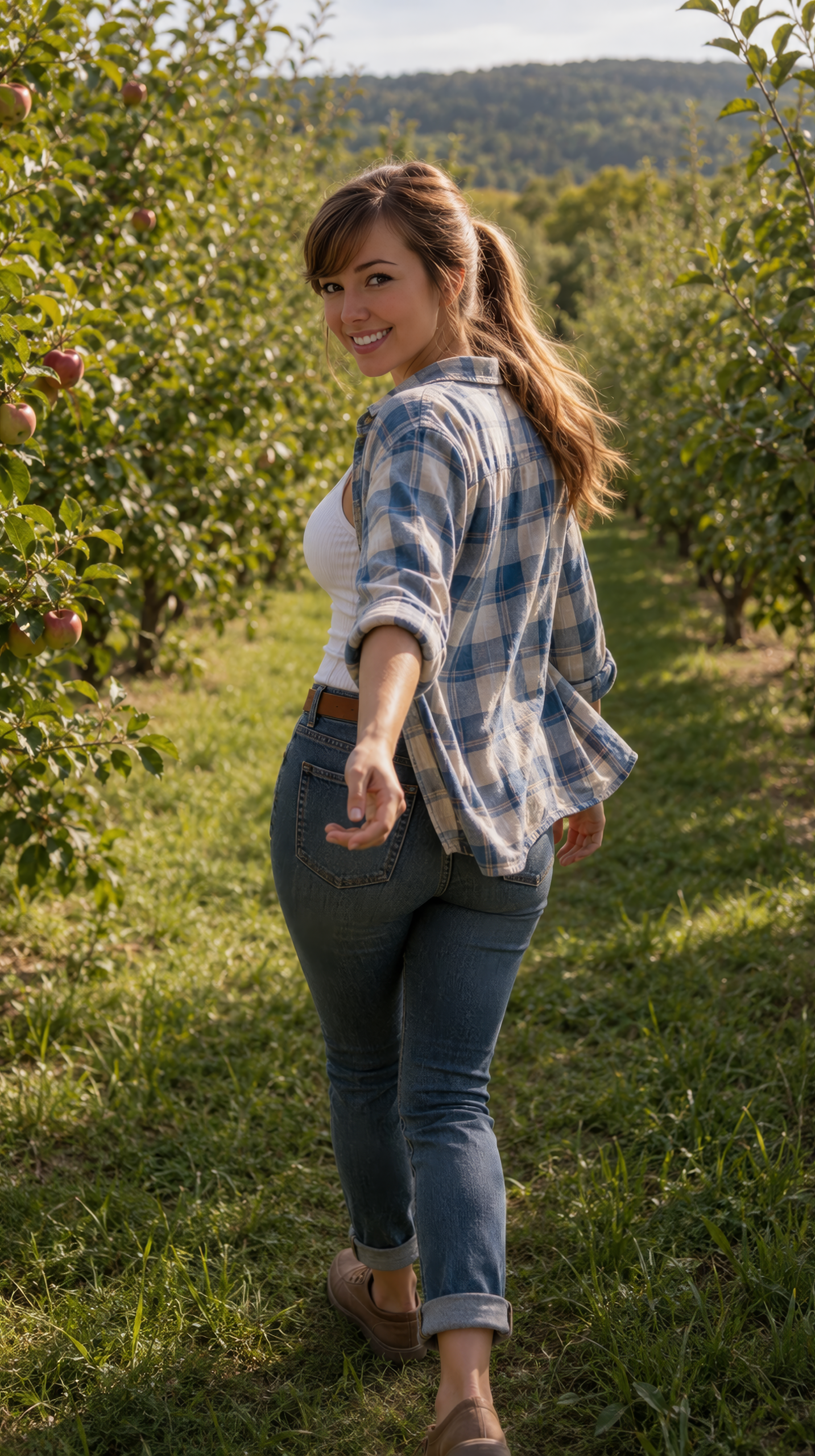
Ruthie took the bucket back, tossed the gloves onto a chair, and started down the porch steps. She was wearing jeans, a white ribbed tank, and an old blue plaid shirt with the sleeves rolled above her elbows. It was the sort of clothing that made no attempt to announce itself and somehow looked so completely right on her that anything more considered would have felt dishonest.
I asked if we needed water.
“There’s a river.”
“I’m not drinking from the river.”
“Then I guess you should’ve brought water.”
She turned at the bottom of the steps and gave me that bright, innocent smile she uses whenever she has been deliberately unhelpful.
Ruthie lives in an old farmhouse near the edge of a narrow Vermont valley, close enough to the river that its sound reaches the back porch after a hard rain. The house belonged to her grandparents, then her parents, and now, in the gradual and legally confusing way family properties sometimes change hands, mostly to her. Her father still refers to the tool shed as his. Her mother continues planting things beside the porch without asking. Ruthie pays the taxes, replaces whatever breaks, and knows better than to claim absolute sovereignty.
The orchard begins behind the house.
Orchard may be too generous a word. There are nine apple trees, although Ruthie counts eleven because two dead ones continue producing a determined handful of fruit every other year. The trees lean at uncertain angles across the slope. None are labeled. Ruthie can identify four varieties with confidence and invents names for the rest.
She stopped beneath one of the smaller trees and gently turned a green apple in her hand.
“Not yet.”
“You can tell from looking?”
“I can tell because it’s August.”
This did seem like information available without touching the apple.
She examined another anyway. Her grandfather planted most of the trees, and he taught her to lift an apple and twist rather than pull. If it comes away easily, it is ready. If the branch resists, leave it alone.
Ruthie demonstrated.
The apple remained attached.
“See?”
“I believed you before.”
“That’s no way to learn.”
There is a practical logic to almost everything Ruthie does, but she likes to conceal it beneath enough teasing that you have to pay attention. She knows when each tree blooms, which one bears only every other year, which apples will keep through winter, and which become soft almost before they reach the kitchen. She makes sauce, butter, cider, pies, and one aggressively spiced chutney that her family pretends to like because nobody wants to discourage her.
The blackberries were not in the orchard.
They grew along the river, beyond the footbridge and around a bend that Ruthie described as “not far.” I have learned that distance means something different to people who grew up walking across their own land. “Not far” can indicate anything from the next fence post to a location requiring emergency provisions.
Ruthie started down the row between the apple trees, then looked back and held out her hand.
“Come on.”
I took it.
She did not let go immediately.
That should probably be mentioned.
The path dropped through the orchard, crossed a narrow strip of meadow, and entered the trees near the river. Ruthie moved quickly, apparently trusting that I could watch the ground, carry the camera, avoid branches, and listen to her explain the property’s history at the same time.
The bridge appeared through the trees with no warning. It was wooden, weathered, and just wide enough for two people if neither objected to becoming familiar. The river ran over rounded stones beneath it, clear in the shallows and dark where it gathered under the far bank.
Ruthie stepped onto the first board.
I stopped.
She looked back.
“What?”
“That plank moved.”
“They all move.”
“That was not reassuring.”
“They’ve moved for thirty years.”
“That is somehow worse.”
She walked backward onto the bridge, holding my gaze and smiling.
“This bridge survived the flood of ’98, the flood of 2011, and Uncle Danny driving a lawn tractor across it when everyone specifically told him not to.”
“Did the lawn tractor survive?”
“No.”
Ruthie turned and continued across.
I followed, although this should not be interpreted as confidence in the bridge. It was confidence in Ruthie, which is a more dangerous habit and considerably harder to explain.
Halfway across, she stopped at the railing. Sunlight moved across the water beneath us. The river was louder there, not violent, but insistent enough that conversation required standing close.
Ruthie leaned over the rail and looked upstream.
“My mother used to make us wash our feet here before we came home.”
“Why?”
“Because we never had shoes by then.”
I glanced at her boots.
“Progress.”
“Temporary progress.”
On the far side of the bridge, the path narrowed until blackberry canes crowded it from both directions. Some of the fruit was still red. Much of it had ripened to a deep glossy black, and several berries were so soft they fell at the slightest touch.
Ruthie handed me the bucket.
“Black ones only.”
“I know what a ripe blackberry looks like.”
She raised one eyebrow.
I picked a berry and held it up.
“That one’s fine,” she conceded.
I dropped it into the bucket.
“You’re supposed to eat the first one.”
“I thought we were collecting them.”
“We are. Starting with the second one.”
Ruthie picked another and ate it. Then she waited until I did the same.
The berry was warm from the sun, sweeter than I expected, and stained two of my fingers purple.
She looked entirely too pleased.
“Now you know.”
“Know what?”
“Whether they’re worth picking.”
This is how Ruthie explains most country rituals. She does not call them traditions. She does not romanticize them. She simply behaves as if there is an obvious order to things, and if you have not learned it yet, she will teach you while pretending to make fun of you.
We picked slowly.
More accurately, Ruthie picked slowly. I photographed her picking slowly.
She reached into the brambles without hesitation, shifting thorny canes aside with one forearm and dropping berries into the bucket at her hip. Her hands moved with the casual certainty of repetition. Twist, release, inspect, drop. Every few minutes she ate one. Every few minutes after that, she accused me of contributing nothing.
“I’m documenting.”
“You’re standing there.”
“Professionally.”
“That explains the expression.”
“What expression?”
“The one where you pretend you aren’t watching me.”
I lowered the camera.
Ruthie smiled and turned back to the berries.
By the time the bucket was half full, the sun had climbed high enough to make the riverbank warm. Ruthie sat on a broad stone beside the brambles, pulled off her boots, and rolled her jeans above her ankles.
“You planned this,” I said.
“I’m taking a break.”
“You told me people always lose their shoes down here.”
“People with poor judgment.”
She stood barefoot and returned to picking.
Apparently Ruthie’s judgment was different.
The ground near the river was a mixture of soft earth, moss, roots, and stones polished smooth by older water. She moved across it easily, occasionally curling her toes against the ground when she reached into the higher canes. I asked whether she was worried about stepping on something.
“Yes.”
“That doesn’t appear to have altered your behavior.”
“I’m being careful.”
“You’re barefoot in the brambles.”
“I didn’t say I was being sensible.”
The bucket grew heavier. The berries at the bottom began staining one another, releasing dark juice around the edges. Ruthie inspected them with the satisfaction of someone mentally assigning each one a future.
Some would become jam. Some were going into a pie. Her mother had requested syrup. Ruthie wanted to freeze several pints for winter, although she admitted that every year she eats enough during the process to reduce the expected yield considerably.
“You need quality control,” she said.
“You’ve been conducting quality control for an hour.”
“I’m thorough.”
She offered me a berry.
I reached for it.
Ruthie pulled it away.
I stared at her.
“What?”
“You offered it.”
“I changed my mind.”
She ate it, smiled, and reached for another.
The second one made it to me.
We carried the bucket to the river and sat on the same broad stone, our backs against the warmth it had collected all afternoon. Ruthie stretched her bare feet across the moss and chose berries individually from the top as though she had not just spent an hour filling the bucket for some supposed practical purpose.
I reminded her about the jam.
“There are plenty.”
“The pie?”
“Still plenty.”
“Your mother’s syrup?”
Ruthie looked into the bucket, selected another blackberry, and held it between two fingers.
“She doesn’t know how many we picked.”
There is a particular pleasure in eating something where it grew. No rinsed carton, no recipe, no waiting until later. Just warm fruit, stained fingers, running water, and Ruthie pretending every berry she chose was necessary research.
Eventually she leaned back against the rock and closed her eyes.
For the first time all afternoon, she became quiet.
The river moved past us. Leaves shifted overhead. Somewhere on the opposite bank, a bird repeated the same three notes until I began to think it had forgotten how the song ended.
I watched Ruthie for a while.
She opened one eye.
“You’re doing it again.”
“What?”
“Pretending you’re not watching me.”
“I have a camera. There isn’t much pretense involved.”
“That’s true.”
She sat up and studied me with a softness that had been absent from her teasing all afternoon.
“Are you having a good day?”
The question caught me slightly off guard.
“Yes.”
“Even with the dangerous bridge?”
“Despite the dangerous bridge.”
“And the lack of water?”
“I drank from the river.”
Ruthie straightened.
“You did not.”
“No.”
She narrowed her eyes, deciding whether to be annoyed. Then she laughed and leaned her shoulder against mine.
We stayed there longer than the blackberries required.
That was becoming something of a pattern with Ruthie. The stated reason for seeing her was always simple. Pick berries. Walk to the river. Help repair a porch step. Bring back a borrowed dish. Somehow the task expanded until evening, and by then leaving felt less like the conclusion of a visit than an interruption.
When we finally stood, Ruthie slipped her boots over her bare feet without bothering with socks. She carried the bucket. I carried the camera. We retraced the path to the bridge as the light began turning warm behind the trees.
Halfway across, Ruthie stopped again.
This time she faced me and rested both hands on the railing.
“What happens to all the pictures?”
“I edit them.”
“Then what?”
“I show them to you.”
“All of them?”
“Most of them.”
“What happens to the others?”
I knew what she was asking. There are always photographs the subject never sees. Blinks. Blurs. Awkward movements. Images that fail technically, and others that succeed in ways too private to explain.
“Some are just mine.”
Ruthie looked down at the water.
“That sounds suspicious.”
“It probably is.”
She turned toward me, sunlight catching the loose strands around her ponytail.
“Do I get to know which ones?”
“No.”
“Do I get veto power?”
“Usually.”
“Usually?”
“Don’t make that face.”
“What face?”
I lifted the camera and showed her.
Ruthie’s expression in the photograph was half accusation, half laughter, the precise moment before she decided which one would win.
“That one,” she said.
“What about it?”
“Keep it.”
We crossed the rest of the bridge without speaking.
Back at the orchard, the apples still needed another week or two. The blackberries had stained the bucket, my hands, and one small patch near Ruthie’s shirt cuff. The afternoon had produced enough fruit for perhaps three jars of jam and enough photographs to make the original errand seem like an excuse.
At the porch, Ruthie took the bucket from me and set it beside the steps.
“You staying for supper?”
I looked toward the house.
“What are we having?”
She considered the question.
“Pie, eventually.”
“You haven’t made it yet.”
“No.”
“So supper is not pie.”
“Not with that attitude.”
She opened the screen door and stood aside, holding it for me exactly as she had that morning.
I stepped onto the porch.
Ruthie remained in the doorway, smiling.
“See?” she said. “Decent shoes.”
I looked down. My boots were muddy, damp, and marked with blackberry juice.
“What about them?”
“They got you back.”
I should have known then that the blackberries were never the point.
With Ruthie, they rarely are.
This gallery was created with the assistance of AI tools.
Want to see more? Create a free account to unlock three additional images, or join All-Access to view the complete gallery.