
Noura: Marrakech, Part Two (29 images)
READ HER STORY
Noura (21)
The camel’s name was apparently Azizi.
I say “apparently” because the man leading him called him Azizi, another guide called him Hamid, and Noura spent the entire ride calling him George.
“Why George?”
“He looks like a George.”
“You were told his name.”
“I was told two names. George breaks the tie.”
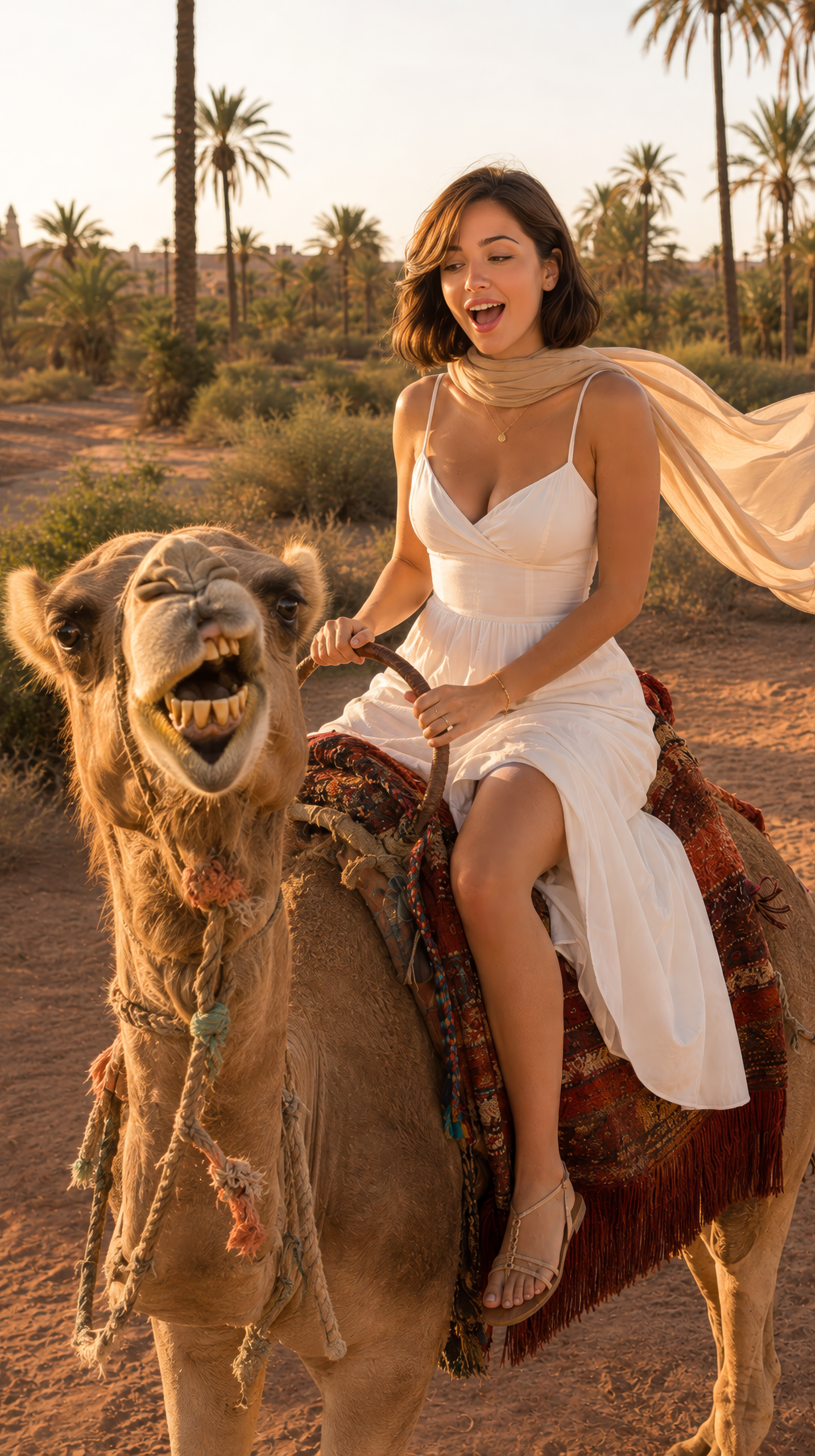
George appeared indifferent to the controversy. He was a broad, sandy-colored camel with enormous feet, an elaborately woven saddle, and the patient expression of someone who had carried thousands of tourists through the Palmeraie and found very few of them memorable. Noura intended to change that.
Our second day in Marrakech began late in the afternoon, after she had decided the morning was too hot for anything ambitious. The previous day had taken us through courtyards, souks, spice stalls, rug shops, and enough narrow passages that I had stopped pretending I knew which direction led back to the riad. Today she wanted open sky.
The Palmeraie stretches beyond the denser parts of Marrakech, a vast landscape of palms, dry earth, low scrub, and scattered buildings. It is not the endless Saharan emptiness visitors sometimes imagine when they hear “camel ride.” The city never completely disappears. Minarets and rooftops remain visible in the distance, and the Atlas Mountains can emerge beyond them when the air cooperates.
Noura liked that.
“You can still see where you came from,” she said. “It just stops being the only thing you can see.”
She wore the same white sundress she had worn through Le Jardin Secret, along with a long sand-colored scarf one of the guides wrapped loosely around her neck. The practical purpose was protection from dust and sun. The visual consequence was considerably more dramatic. As soon as the wind caught it behind her, she looked like a woman who had arrived with an entire film crew and a contractual obligation to appear magnificent at sunset.
I told her so.
She looked down at George.
“Did you hear that? We’re magnificent.”
George continued chewing.
Mounting him was the first challenge. A camel does not rise like a horse. The rear legs straighten first, pitching the rider forward, then the front legs follow and throw everything backward. The guide warned Noura to lean with the movement. Noura nodded with the confidence of someone who had completely understood.
She had not.
George stood, Noura lurched forward, released a noise somewhere between a laugh and a shriek, then clutched the saddle while the scarf flew across half the frame.
“You knew that was going to happen,” she accused me once she was upright.
“I was specifically waiting for it.”
“You’re a terrible friend.”
“I got the photograph.”
She considered that.
“Let me see.”
It was not flattering in any conventional sense. Her eyes were enormous, her mouth was open, and one hand appeared to be negotiating separately with gravity. Noura studied it for several seconds and started laughing.
“Keep that one.”
She understands something about photographs that many beautiful people never learn. A picture does not have to make her look perfect to become worth keeping. Sometimes the imperfect ones contain more of the day.
Once we started moving, she relaxed quickly. The path wound between palms while the late sun stretched every shadow across the ground. Noura sat high above me, one hand resting on the curved saddle grip, looking from the landscape to George and back again. Every few minutes, she asked the guide a question.
How old was George?
Did he always work with the same camels?
Where did they sleep?
What did they eat?
Could camels recognize individual people?
Did George like her?
The guide answered patiently until that final question.
“He likes everyone,” he said.
Noura looked wounded.
“I thought we had something special.”
George turned his head slightly, although probably not for emotional reasons.
She leaned forward and patted his neck.
“Don’t listen to him. He doesn’t understand us.”
For all her joking, Noura was attentive to how the animals were handled. Before booking anything, she had read reviews, looked for recent photographs, and asked enough questions that I briefly thought the excursion might collapse beneath the weight of her investigation. She has ridden camels before, and she knows there is a difference between an animal working and an animal being mistreated. She watched George’s gait, checked the saddle, and quietly observed the handlers before deciding she was comfortable proceeding.
This is part of the way she travels too. Curiosity without attention can become consumption. Noura wants the experience, but she also wants to understand what her presence is supporting. She does not always get it right. She would be the first to say so. Still, she asks.
The farther we went, the more the city softened behind us. The air cooled. Her scarf streamed over one shoulder, the white skirt gathered across the saddle, and the palms stood black against a sky turning honey-colored near the horizon.
For a while, she stopped talking.
That is rare enough that I noticed.
Noura is not someone frightened by silence, but she is usually interested in whatever might fill it. A question. A story. A ridiculous observation about a camel’s personality. This time, she simply watched the light move through the trees.
I asked what she was thinking.
“That I’m lucky.”
The answer came without hesitation.
Then she glanced toward me.
“I know that sounds obvious.”
It did, in some ways. Noura’s life is built on opportunities most people will never receive. Her family’s money made this freedom possible. She did not save for years to come to Marrakech. She did not negotiate vacation days, hunt for the cheapest flight, or return home wondering whether the trip would remain on a credit card until Christmas. She could extend her stay tomorrow if she wanted.
Noura never pretends otherwise.
“I used to feel like I had to apologize every time I enjoyed something,” she said. “But apologizing doesn’t make anything fairer. It just makes gratitude sound guilty.”
“So what do you do instead?”
“Try not to waste it.”
She looked toward the palms again.
“Not the money. The chance.”
That answer has stayed with me.
Noura’s travels can look effortless from the outside. Beautiful hotels, unfamiliar cities, perfect light, linen dresses, late dinners, and another flight whenever restlessness returns. But the defining luxury of her life is not where she goes. It is time. She can remain curious after most people would need to hurry home. She can return when a place proves larger than the days she gave it. She can follow the next question without first asking whether she can afford the answer.
She knows what that is worth.
The sun was sinking when we turned back. George seemed to recognize the direction and adopted a slightly more purposeful pace. Noura took this as proof that he had enjoyed the outing and wanted to conclude it on a professional high note.
“He is thinking about dinner,” I said.
“You don’t know him.”
“I understand him better than you think.”
At the end of the ride, George folded himself toward the ground. Noura remembered the sequence this time, leaned correctly, and dismounted with enough grace to look disappointed that there had been no second disaster.
She thanked the guides, tipped generously, and asked if she could give George something. One of the men handed her a small piece of fruit. George accepted it, immediately looked for another, and briefly became the most attentive creature in Morocco.
Noura stroked the side of his face.
“I knew he loved me.”
“He loves produce.”
“Jealousy is ugly on you.”
Back at the riad, she showered away the dust and changed into a pale champagne-colored slip dress. I expected dinner. Instead, she opened the balcony doors, gathered several cushions into the last sunlight, and retrieved the little journal she carries almost everywhere.
Noura does not keep a conventional travel diary. There are no daily summaries beginning with where she woke and ending with what she ate. She writes fragments. Things people say. Foods she wants to remember. Street names spelled three different ways. Questions she forgot to ask. Tiny observations that would mean nothing to anyone else.
She showed me one page from the previous day.
The blue thread in the rug shop.
Orange blossom water, but less than you think.
Ask why the lanterns have colored glass.
Man carrying twelve chairs on one motorbike.
Dates are becoming a logistical concern.
I asked whether these notes ever became anything.
“They become memory.”
“You already have a memory.”
“Not a trustworthy one.”
She uncapped her pen and added another line.
“What did you write?”
“George.”
“Anything about the camel?”
“That is about the camel.”
She wrote for a while, occasionally pausing to look through the arched opening toward the Koutoubia. Then she closed the journal, picked up the book she had been pretending to read since we arrived, and stretched across the cushions.
I say pretending because she had been on the same chapter for three days.
“You keep distracting me,” she said.
“You’ve taken the book into two markets and onto a roof.”
“I like having options.”
“You have not read it in any of those places.”
“That doesn’t make it less useful.”
She tried again. For several minutes, she appeared genuinely absorbed. Then the evening call to prayer began carrying across Marrakech, rising from one direction and then another until the city seemed to answer itself.
Noura lowered the book.
Although she is Egyptian-American, Arabic is not the language in which she feels most fluent. She knows enough to recognize familiar phrases, enough to catch pieces of conversations, and enough to know precisely how much remains beyond her. The calls she heard growing up were usually through recordings, family visits, or occasional trips to Egypt. Here, the sound moved through open air and across rooftops, woven into the rhythm of a city that was not hers and did not need to become hers for the moment to matter.
She listened without photographing it.
Eventually, she set the book beside her.
“Still on the same chapter?” I asked.
“Worse. Same page.”
The last light turned the room gold. Noura poured mint tea, sat cross-legged among the cushions, and watched Marrakech darken beyond the balcony. After the constant movement of the souks and the strange swaying rhythm of the camel, the stillness felt almost ceremonial.
Travel with Noura is not restful in the conventional sense. She can spend twelve hours walking and still suggest going out for dessert. She will wake early for light, stay late for music, and sacrifice sleep to any conversation that becomes interesting after midnight. Yet she protects these pockets of nothing with surprising seriousness. An hour beside an open window. Tea without a reservation waiting afterward. A book she may or may not read. Time deliberately left unclaimed.
That night, she claimed the bath.
The tub was built into a tiled alcove, surrounded by blue-and-white mosaic, carved mirrors, brass fixtures, and enough Moroccan lanterns to create the impression that bathing required a minor religious festival. Noura filled it with bubbles, lit nearly every candle she could find, and carried in a bottle of red wine.
I looked at the arrangement.
“This seems safe.”
“The candles are on stone.”
“I meant the wine in the bath.”
“That’s safer than wine on a camel.”
I could not argue with that.
She poured a glass and settled beneath the bubbles. The white slip dress stayed on because, according to Noura, removing it would turn a perfectly elegant evening into laundry logistics neither of us wished to discuss. The water darkened the fabric beneath the foam while candlelight moved across the tiled walls.
There was something almost absurdly indulgent about it. The wine. The lanterns. The embroidered red robe draped beside the tub. A bath large enough to swim a very small lap. Noura knew it too.
She lifted her glass.
“To not wasting the chance.”
“You’re applying that philosophy to a bubble bath?”
“I apply my principles consistently.”
She took a sip, leaned back, and closed her eyes.
The day had begun above the ground on the back of an animal she insisted was named George. It ended beneath a mountain of bubbles while Marrakech glowed through colored glass. Between those moments, Noura had written half a page, read perhaps two paragraphs, asked dozens of questions, and admitted one thing about herself that explained more than any passport count could.
She is lucky.
She knows it.
The knowledge has not made her smaller or ashamed. It has made her attentive. She tips well, buys from people whose work she admires, gives more than she needs to, stays long enough to listen, and tries to remember that access is not the same as understanding. Her life lets her cross borders easily. Curiosity is what keeps those crossings from becoming empty.
Near the end of the evening, I climbed onto a stool above the bath to photograph the full room. From there, Noura appeared surrounded by mosaic, candlelight, lanterns, scarlet fabric, bubbles, and the various objects she had accumulated over two unfinished days in Marrakech. She looked up at me with the amused patience of someone indulging a very questionable artistic decision.
“If you fall,” she said, “I’m saving the camera first.”
“I appreciate your honesty.”
“I’m wearing wet silk. I have limitations.”
I took the photograph.
When I climbed down, Noura had placed the wine beside the tub. She stretched beneath the bubbles, rested one arm along the edge, and gave me a quiet smile.
“Are we finished?”
“With Marrakech?”
She laughed.
“No. Obviously not.”
That was the problem with asking Noura what came next. Every ending became another invitation. There were still gardens she wanted to revisit, foods she had only heard about, streets we had passed too quickly, and a disputed list of dates she intended to compare scientifically. Somewhere in her journal, beneath the reminder about colored glass and the single word George, Marrakech had already begun expanding again.
The city was not hers to possess.
It did not need to be.
For Noura, loving a place has never meant finishing it. It means leaving with enough unanswered questions to justify returning.
This gallery was created with the assistance of AI tools.
Want to see more? Create a free account to unlock three additional images, or join All-Access to view the complete gallery.