
Nadia: Ten Days of Summer (27 images)
READ HER STORY
Nadia (26)
Nadia buys the ten-day pass every year. Not because it saves money, although she has done the arithmetic and will happily explain that it does. She buys it because one day at the state fair requires choices, and Nadia refuses to choose between the livestock barns, the midway, the vegetable judging, the tractor pull, and eating something fried beneath enough powdered sugar to alter the color of her dress. Ten days means she can see everything. It also means she can return to whatever she loved the first time, which is often everything. When she invited me to join her on opening day, she gave me three rules: wear comfortable shoes, arrive hungry, and do not make fun of how seriously she takes the vegetable exhibits. “People worked all summer on those,” she said. “That pumpkin didn’t get enormous by accident.” She was waiting beneath the entrance arch when I arrived, holding her pass beside her face like she had just won something. In a way, she had. Other people enter the fair looking for directions. Nadia enters as if she has come home.
She has attended nearly every year since childhood. Her father brought her first, although he cared mostly about the tractors and could spend an indecent amount of time discussing horsepower with strangers. Her mother liked the exhibition halls, especially the quilts and preserves. Nadia loved all of it. She remembers being small enough to sit on her father’s shoulders during the parade and old enough to feel embarrassed when he continued offering after she had clearly outgrown the arrangement. She remembers the year rain flooded half the midway, the year a runaway goat delayed a livestock showcase, and the summer she won a stuffed dog so enormous that her mother made it ride home in the passenger seat. “I was in the back,” she told me. “The dog had called shotgun.” The fair became the marker she used to divide one summer from the next. School years changed, friends came and went, and eventually her parents stopped attending all ten days, but Nadia kept buying the pass. She says some people need a cabin by a lake or a particular stretch of beach. She needs the smell of hay mingling with fryer oil while a tractor engine growls somewhere in the distance.
Our first stop was the agriculture pavilion, which surprised me only because I had expected food. Nadia informed me that the food would still be fried in twenty minutes, while the prize vegetables were best appreciated before the crowds arrived. She moved slowly along the tables, reading entry cards and studying blue-ribbon cabbages with the thoughtful attention most people reserve for paintings. A pumpkin nearly as wide as the table stopped her completely. She leaned forward, clasped her hands behind her back, and whispered, “Absolute unit,” with something close to reverence. When I laughed, she reminded me of the third rule. She did not grow up on a farm and has never raised anything more agriculturally ambitious than patio tomatoes, but she is fascinated by the quiet obsession required to produce a perfect ear of corn or a squash large enough to frighten a toddler. The judging, she explained, is partly about the vegetables and partly about seeing what happens when ordinary people devote unreasonable amounts of patience to something they love. I realized she could have been describing herself and the fair.
The livestock buildings brought out a softer version of her. She greeted piglets as if they were old friends, crouched beside the duck enclosure, and allowed a friendly goat to chew the hem of her dress for several seconds before deciding affection had become vandalism. The poultry barn contained her favorite discovery of the afternoon, an enormous rooster with the posture of a county official and the expression of a man who had recently denied someone a permit. Nadia pointed at him, looked directly into my camera, and said, “That one has definitely ruined a town meeting.” She wanted a photograph with him but refused to stand too close because, in her words, “He has political enemies, and I don’t need to become collateral damage.” A few stalls later, someone placed a lamb in her arms. The jokes stopped. She settled onto the hay, drew it against her chest, and lowered her face until her cheek rested against its wool. For a moment, she forgot both me and the camera. That image became one of my favorites from the entire day, not because she looked beautiful, although she did, but because it showed how quickly her delight could become tenderness.
By late afternoon, the tractor pull had begun. Nadia claimed a place beside the rail with the confidence of someone who knew precisely where the dirt would fly without reaching us. The grandstand filled, engines roared, smoke climbed into the golden sky, and she attempted to teach me the finer points of weight transfer while shouting over machinery designed to make conversation impossible. Her enthusiasm was contagious even when her explanation was not. She cheered for the oldest tractor, chose favorites based on names she liked, and squeezed my arm whenever one came close to a full pull. Between runs, I asked whether her father still came with her. “Usually one day,” she said. “He says ten is excessive now.” Then she smiled toward the track. “He’s wrong, obviously.” There was affection in the answer, but something else too. Traditions do not remain unchanged merely because we keep them. Sometimes returning to the same place is how we measure everything that has changed around it.
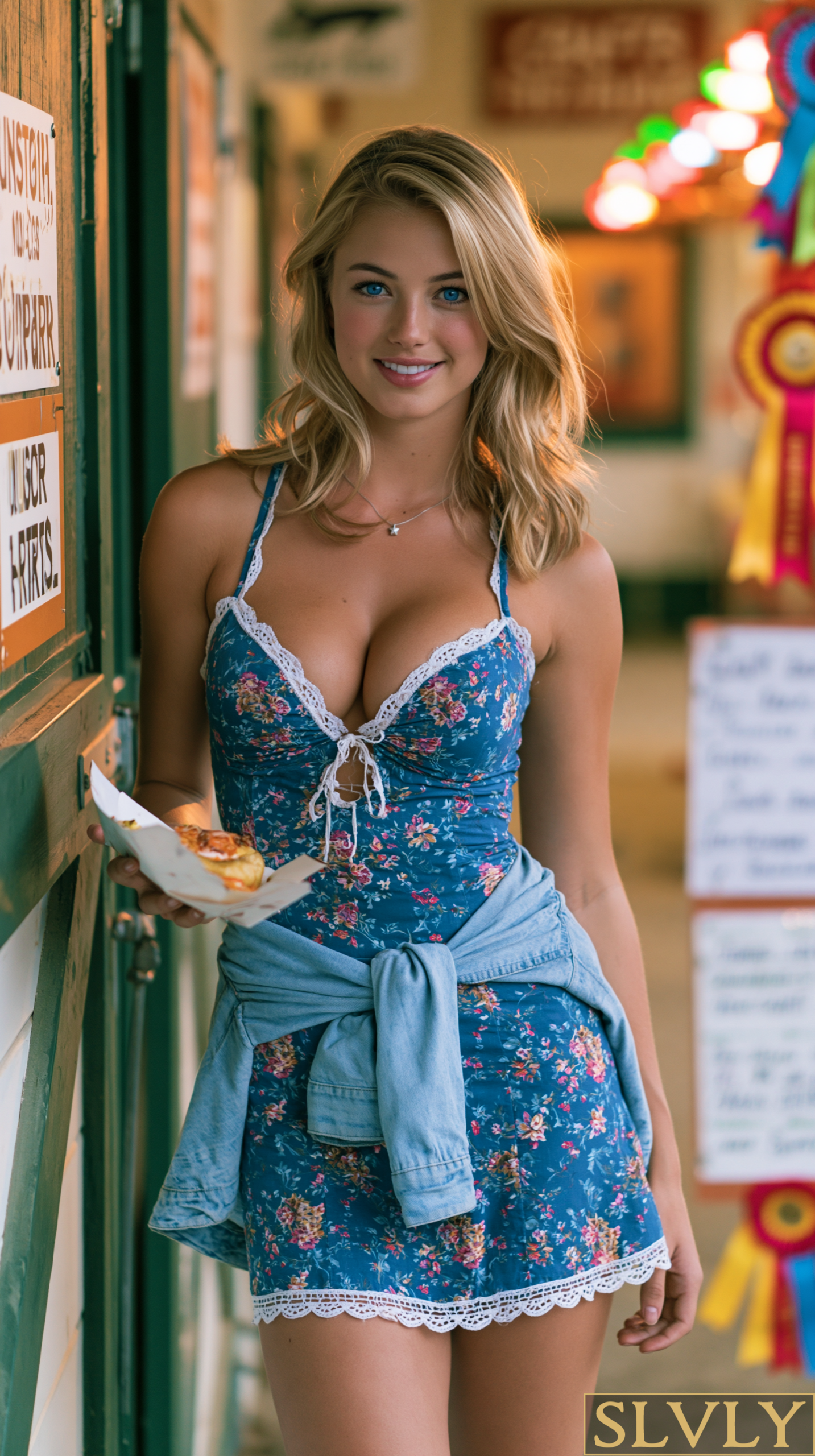
At dusk, the fair transformed. Agricultural exhibits closed, barn lights glowed against the darkening sky, and the midway took command. Nadia bought fried dough and tore off the first piece before I could photograph it. She accused me of trying to make food cold for artistic reasons, then held up the remaining half as a compromise. We followed it with lemonade, fried cheese, and cotton candy so large that carrying it through the crowd became a logistical problem. She insisted she could finish it alone. She could not. I helped, which she characterized as an act of betrayal against the integrity of the experiment. Somewhere between the food stands and the midway games, the outing shifted. The woman who had spent the afternoon teaching me about prize pumpkins and poultry politics became more aware of the camera, then more aware of me. She walked closer. Her teasing acquired a quieter edge. When I offered to hold her denim shirt, she tied it more tightly around her waist and said I needed my hands free because she intended to win something at the bottle toss.
She did not win. She blamed the bottles, the ball, the attendant, and atmospheric conditions. I won her a small stuffed bear on my second attempt, which she accepted with the graciousness of a dethroned monarch trying to preserve diplomatic relations. “You understand,” she said, tucking it beneath her arm, “that I softened them up for you.” We rode two midway attractions she described as “gentle” and I would describe as a brightly illuminated assault on the inner ear. She laughed through both, hair flying across her face, and looked insultingly steady when we stepped back onto the pavement. I asked whether the Ferris wheel was another gentle ride. “That depends,” she said. “Are you afraid of heights?” I told her I was not. “Good. Then it depends on whether you’re afraid of me.”
At the top, the fair looked smaller and stranger. The noise softened beneath us, the livestock barns became dark rectangles beyond the midway, and the crowds dissolved into moving lines between pools of colored light. Nadia sat beside me rather than across from me, her bare shoulder warm against my arm. She pointed out the tractor arena, the agriculture pavilion, and the gate where we had started nearly fourteen hours earlier. From above, her ten-day ritual suddenly made sense. The fair was not one attraction or one kind of pleasure. It was machinery and animals, competition and sugar, childhood memory and adult freedom, rural tradition wrapped in neon. It was everything she was not supposed to love all at once, without embarrassment or qualification.
She reached for my camera and turned it toward us. The first photograph was crooked. In the second, she smiled. For the third, she leaned into the lens and blew a kiss. I told her she had nearly covered the entire frame with her face. “That was the intention,” she said. Then she lowered the camera but did not move away. For one suspended moment, with the car rocking gently and the fair glowing below, she looked as though she might kiss me instead of the lens. Maybe I looked the same way. The wheel began descending before either of us tested the question.
At the exit, Nadia still had nine days left on her pass. She ate the final bite of something fried, thanked the attendant as we passed through the gate, and looked back at the Ferris wheel. I assumed she was tired. She was already planning her return. There were rabbits we had not seen, a pie contest on Tuesday, harness racing on Wednesday, and a demolition derby she considered mandatory. She asked which day I wanted to come back.
I reminded her that she had originally invited me for opening day.
“I know,” she said. “I’m inviting you again.”
That is Nadia’s particular gift. She does not merely enjoy things. She makes room inside her enjoyment and pulls other people into it. By the end of one impossibly long day, I understood why she needed the ten-day pass. There was still too much left unseen, too much left uneaten, and at least one unfinished moment waiting near the top of the Ferris wheel.
This gallery was created with the assistance of AI tools.
Want to see more? Create a free account to unlock three additional images, or join All-Access to view the complete gallery.