
Luthien: What We Left Beside the Water (29 images)
READ HER STORY
Luthien (27)
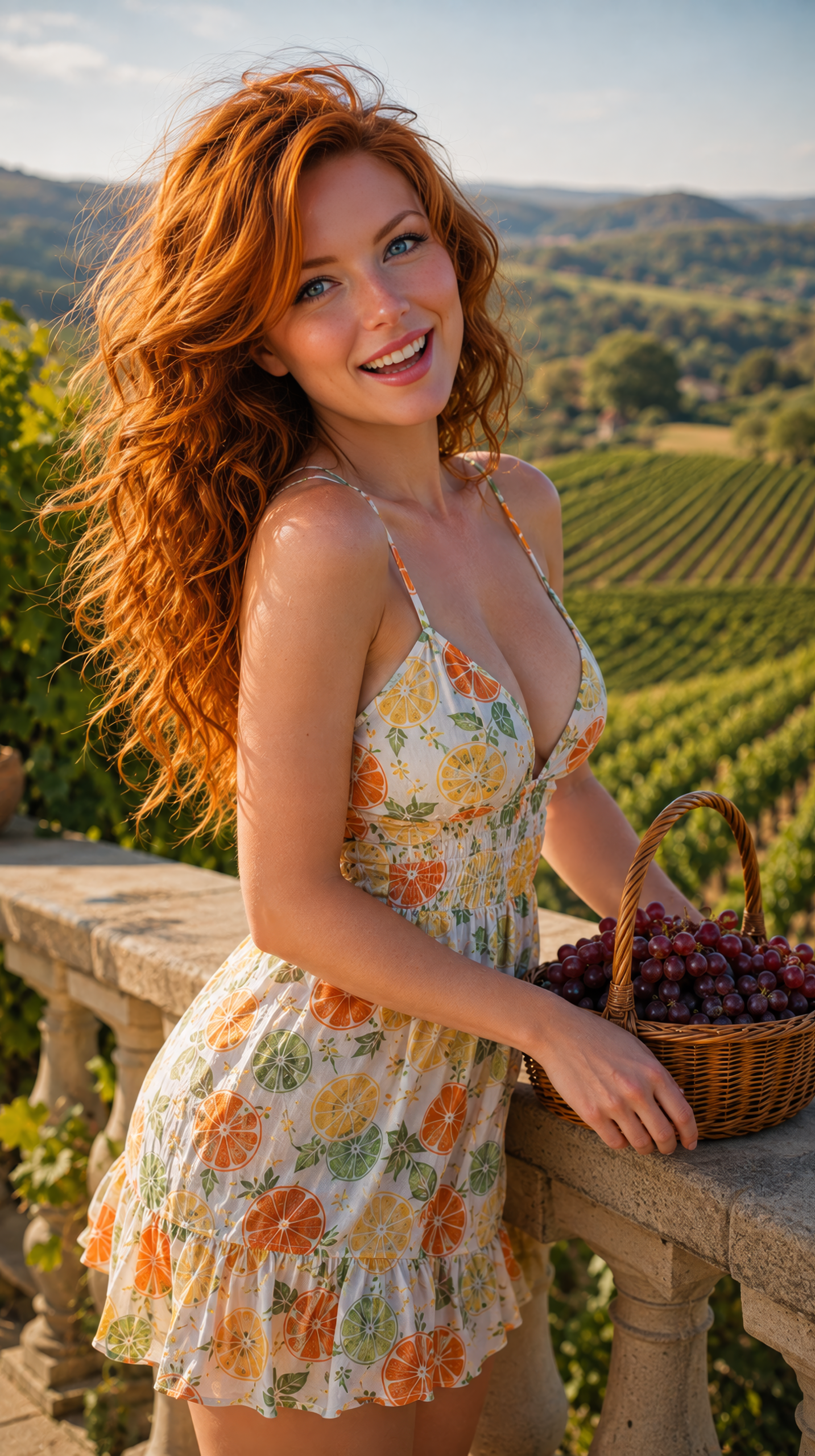
Luthien invited me to the vineyard because she wanted to steal grapes. She used the word “steal” despite the fact that the vines belonged to her aunt, the basket belonged to her aunt, and her aunt had specifically told her to take as many as she wanted. According to Luthien, permission merely made it a very low-risk heist. She arrived in a white sundress covered with oranges, lemons, and limes, which seemed wildly optimistic for an afternoon spent among dark grapes and dusty rows. When I pointed this out, she looked down at herself as though seeing the dress for the first time. “Then you’ll have photographic evidence of every bad decision,” she said. That turned out to be a fairly accurate description of the day. I had expected an hour of photographs among the vines, perhaps a glass of wine on the terrace, and home before sunset. Luthien had apparently planned something else, although I am not convinced she knew what it was until it started happening.
The vineyard belonged to her mother’s older sister, who had moved there nearly twenty years earlier after falling in love with the land, the farmhouse, and eventually the quiet man who owned both. Luthien spent parts of her summers there growing up. She knew which rows produced the sweetest table grapes, where the irrigation line always leaked, and which stone wall stayed warm long after the sun disappeared. She also knew exactly how many grapes she could eat before anyone noticed the basket was not filling as quickly as it should. “Quality control,” she explained, holding one near her lips while I photographed her. “You’ve been performing quality control for half an hour.” She bit into it and smiled. “Standards matter.” There was something different about her there. Luthien is usually polished in the way people become polished when they know they are being watched. She understands the camera, knows her angles, and can turn a glance into an event. At the vineyard, that confidence remained, but it was mixed with something younger and less guarded. She wandered ahead of me, disappeared between rows, and called my name from places she knew I could not immediately see. Every time I caught up, she was leaning against a post, sitting with the basket in her lap, or waiting with another grape held close to her mouth as if I had interrupted a private conspiracy.
Her aunt had left a note suggesting we bring the basket to the terrace when we finished. Underneath it, she had added, “There is chilled wine in the kitchen,” followed by two underlined words: “For later.” Luthien read the note aloud and said her aunt had always possessed an unnecessarily suspicious mind. We carried the grapes uphill, although “we” is generous. Luthien carried them when she liked how the basket completed the picture and handed them to me whenever the path became steep. By the time we reached the terrace, the light had softened across the valley. The vineyard fell away below us in green lines, the hills beyond it turning hazy and blue. I set the basket on a small table and expected her to sit down. Instead, she caught the hem of her dress in both hands and spun once beneath the pergola. It was not a pose so much as an eruption of energy. I made the photograph almost by instinct. “Again,” I said. “That wasn’t for you.” “Do it again anyway.” She narrowed her eyes, but she was already smiling. The second turn was slower, more deliberate, and unmistakably for me. That was the moment the afternoon changed.
Until then, Luthien had been showing me a place she loved. On the terrace, she began playing with the fact that I was looking at her. She walked barefoot across the warm stone, lifted the skirt just enough to let it catch the breeze, then glanced back to see whether I had followed. When I asked what she was doing, she said, “Improving your terribly dull vineyard photographs.” I reminded her that most of those photographs were already of her. “Exactly,” she replied. We opened the wine but scarcely touched it. Luthien sat beside the basket and continued eating grapes one at a time, maintaining eye contact with such exaggerated innocence that it became impossible to believe in her innocence at all. She asked whether I photographed every woman the same way. I said no. She asked what made her different. I told her that most people eventually became self-conscious when the camera stayed on them long enough. Luthien seemed to become more herself. For once, that answer silenced her. She looked over the valley, rolled the stem of a grape between her fingers, and said quietly, “Perhaps I like being seen by the right person.”
She rescued me from having to answer by standing abruptly and announcing that the best part of the property was farther downhill. She left the basket, the wine, and eventually her sandals behind. We followed a narrow path beyond the last rows of vines, past a pair of cypress trees and through a low garden where the evening air smelled of rosemary. The private pond appeared below us, ringed with pale stone and reflecting the orange sky. I had glimpsed it from the terrace but assumed it was ornamental. Luthien informed me that her cousins had learned to swim there, her uncle claimed it was fed by a spring, and everyone in the family had been instructed not to ask too many questions about what lived at the bottom. “Reassuring,” I said. “You worry too much.” “You told me bears preferred photographers earlier.” “That was someone else.” “No, it wasn’t.” She shrugged. “Then I was right twice.”
She walked toward the water with her back to me, the straps of her dress slipping gradually from her shoulders. At first, I thought it was accidental. Then one strap fell, she turned her head, and the look she gave me removed all remaining ambiguity. I lowered the camera slightly. Luthien noticed. “Why did you stop?” she asked. I told her I wanted to be certain. She held my gaze for a moment, then let the second strap slide. “Be certain faster.” There are moments when photographing someone feels like preserving what is happening, and others when the camera becomes part of what is happening. This was the latter. She knew precisely what she was doing, but there was no performance in the usual sense. She was not trying to look desirable for an anonymous audience. She was testing the space between us, taking one playful step and waiting to see whether I would meet her there. The dress slipped lower while her back remained turned. She looked over her shoulder, amused by my sudden caution and perhaps pleased by it too.
At the edge of the pond, she gathered the dress and placed it on the stones. The breeze moved through her hair, turning its copper edges almost gold. Then she stepped into the water without hesitation and immediately gasped. “Warm?” I asked. “Perfect,” she lied. She went deeper until the surface reached her collarbones, then turned toward me with a triumphant smile, as if entering cold water at sunset proved something important. I stayed on shore, guarding the camera and the abandoned dress. Luthien accused me of cowardice. I told her one of us needed to remain responsible. “That has never been me,” she said, and pushed away from the edge. She floated on her back for a while, watching the sky change above her. The teasing quieted. The vineyard, the basket, and the wine had all been left uphill, and the world seemed to narrow to water, stone, and the soft sound of her moving through it.
Eventually, she swam back and rested her crossed arms on the rock beneath me. She laid her cheek against them and looked up with an expression that was softer than anything she had given the camera all afternoon. It was not the mischievous Luthien stealing grapes, nor the confident woman turning beneath the pergola, nor the deliberate flirt letting her dress fall from her shoulders. For a few seconds she looked completely unguarded. I took one photograph, then put the camera down beside me. “Only one?” she asked. “That one was enough.” She studied me, perhaps deciding whether I meant it. Then she lifted a wet hand and placed it over mine. “You know,” she said, “my aunt is going to assume this was a date.” I asked whether her aunt was wrong. Luthien smiled against her folded arms. “She usually isn’t.”
We stayed until the sun dropped behind the hills and the pond lost its gold. By the time Luthien climbed out, she was shivering too hard to pretend otherwise. I handed her the dress, turned my back, and listened to her laugh at this late display of modesty. We returned to the terrace barefoot, sharing the basket between us. The chilled wine was no longer particularly chilled, but we poured two glasses anyway. From the table, the discarded grape stems, untended camera bag, and dust on her once-pristine dress made the afternoon look messier than it had begun. Luthien lifted her glass toward the darkening vineyard and asked whether I had gotten what I came for. I told her I had expected photographs of a woman picking grapes. “And instead?” she asked. I looked downhill toward the pond, then back at her. “I’m still deciding.” She smiled as if that were exactly the answer she wanted.
This gallery was created with the assistance of AI tools.
Want to see more? Create a free account to unlock three additional images, or join All-Access to view the complete gallery.