
Jordice: The Things She Knows by Heart (27 images)
READ HER STORY
Jordice (31)
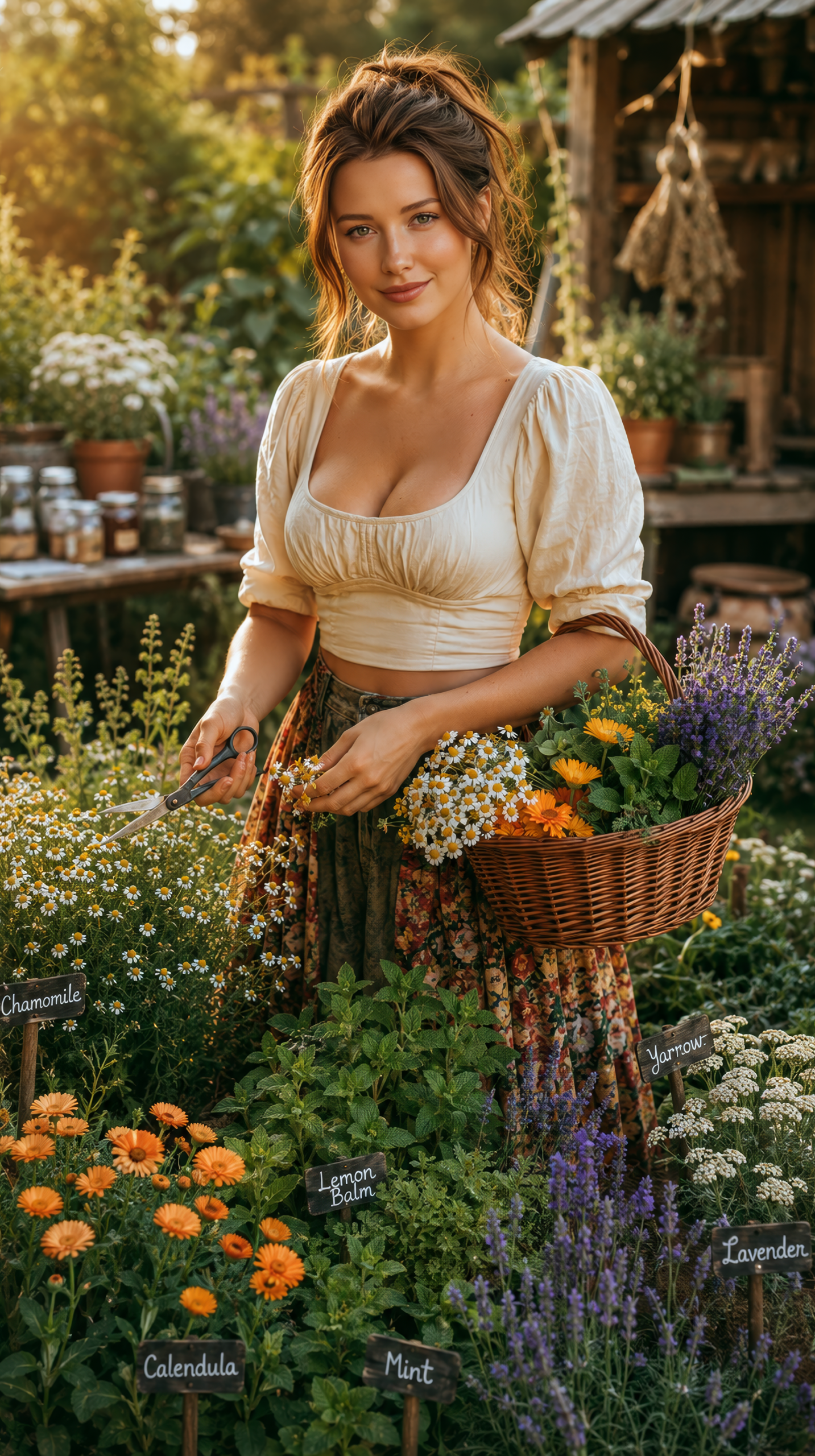
Jordice told me there were two rules in her herb garden. The first was not to pick anything unless I knew what it was. The second was not to pretend I knew what it was. “Those sound suspiciously like the same rule,” I said. She crouched beside a patch of chamomile and clipped several stems into the basket on her arm. “You’d be surprised.” Jordice is thirty-two, and she has spent most of her adult life learning the usefulness hidden inside ordinary-looking plants. Chamomile, calendula, lavender, lemon balm, mint, yarrow. Some become teas or tinctures, some go into oils and salves, and some she grows simply because she likes having them nearby. Her little workshop sits at the edge of the garden, half shed and half apothecary, with bundles of herbs drying from the rafters and shelves crowded with jars whose handwritten labels make considerably more sense to her than they do to me. I arrived expecting to photograph a woman making herbal remedies. Jordice apparently expected me to work. Within ten minutes she had pushed a basket into my hands and was quizzing me on plants. I correctly identified lavender. She congratulated me with the enthusiasm normally reserved for a child who has successfully located his own shoes.
The garden is more orderly than it first appears. Jordice plants in loose patches rather than straight rows, letting calendula spill into the chamomile and allowing mint exactly as much freedom as she thinks it can handle. Small wooden signs mark the plants for visitors, although she admitted she rarely reads them herself anymore. She moves through the beds by memory. She knows which corner stays wet after rain, which lavender plants suffered through the winter, where the yarrow spreads fastest, and exactly how far the mint can advance before she declares war. “Mint doesn’t respect property lines,” she told me, snipping a handful. “You give it an inch and eventually you’re living in its garden.” I followed while she filled the basket with flowers and fragrant green stems, stopping whenever the light caught her through the plants. She was patient with the camera until I asked her to repeat something she had already done naturally. “You missed it?” “I was changing lenses.” “Sounds serious.” “Devastating.” She shook her head, reached back into the chamomile, and very deliberately performed the least natural-looking herb harvest I have ever witnessed. Then she laughed, forgot she was posing, and gave me the photograph I had wanted in the first place.
Her interest in herbs began with her grandmother, although Jordice is quick to separate family tradition from the mythology people sometimes attach to it. Her grandmother gardened, canned, dried herbs, and kept a tin of homemade calendula salve in a kitchen drawer. There was nothing mystical about it. “She used what she had,” Jordice said. If somebody scraped a knuckle, the tin appeared. If the children were restless at bedtime, there was chamomile tea. If something required an actual doctor, they went to an actual doctor. Jordice liked that practicality. In her twenties she began studying plants more seriously, first because she wanted to reproduce a few of her grandmother’s recipes, then because one plant led inevitably to another. A few raised beds became most of the backyard. A shelf of jars became a room. Friends began asking for tins of salve and little bottles of infused oil. Eventually people she had never met started asking too. She now sells small batches locally, but refuses to scale the operation beyond what she can grow, source responsibly, and make herself. “Everyone tells you to grow the business,” she said, tying a fresh bundle beneath the drying rack. “Nobody asks whether you liked the size it was.”
That afternoon she was making calendula salve. This process is considerably less witchy than the workshop makes it look. There are amber bottles, dried flowers, wooden mortars, dangling herbs, handwritten recipes and enough mysterious jars to convince an imaginative visitor that Jordice occasionally turns people into frogs. In reality, she measures everything obsessively. She keeps notebooks. She labels batches. She records dates and ratios and crosses out recipes that did not behave the way she expected. She showed me one page filled with revisions and tiny margin notes. “You know,” I said, “this is disappointingly scientific.” She looked genuinely offended. “Did you think I whispered instructions to the moon?” I gestured toward approximately forty bundles of drying plants hanging overhead. “You have created an atmosphere.” She conceded the point. Still, there was something beautiful about watching her work. She crumbled dried blossoms between her fingers, measured oils, warmed wax, poured a deep golden infusion into little containers and moved among the clutter without ever searching for what she needed. Her hands knew the room. When she finally held up a finished tin labeled Calendula Salve, she looked absurdly pleased with it. I told her to hold still. “Product shot?” she asked. “Proud mother.” She rolled her eyes, but the smile stayed.
By late afternoon, we had been working long enough for the shoot to become less formal. Jordice loosened her hair. The garden light turned golden, and whatever reserve she had shown at the beginning of the day disappeared with it. She leaned across the worktable to smell a bundle she had just gathered, closed her eyes, and forgot about me for a few seconds. Later she picked two enormous daisies and held them over her eyes. I asked what possible medicinal purpose that served. “Improves photographers.” “How?” She puckered her lips beneath the flowers. “Morale.” That image may be the least informative photograph I took all day and perhaps the one that explains Jordice best. She takes the work seriously without needing to take herself seriously. She knows enough to be cautious about what she claims, enough to recognize what she does not know, and enough to laugh at the image people sometimes project onto a pretty woman surrounded by dried herbs. When somebody once called her a woodland enchantress at a market, she thanked him and then spent ten minutes explaining why he still needed sunscreen.
Near sunset, she changed out of the long floral skirt she had worn in the garden and pulled on denim shorts, although the cream top stayed. Harvesting was finished. The jars were sealed, the worktable had been mostly cleared, and the last bundles hung from the rafters. I thought we were done. Jordice sat on the wooden step outside the workshop and told me I was welcome to stay until the light disappeared. By then the warm air smelled like lavender, crushed mint, dried grass, and whatever she had been infusing inside. She looked different when there was nothing left in her hands. All afternoon she had been clipping, sorting, tying, measuring, pouring, labeling. Now she simply leaned against the old boards and let the evening settle around her. I photographed her once from the side. She noticed, turned toward me, and gave me the sort of look that makes a photographer briefly forget which button does what. “Still working?” she asked. “Apparently.” She smiled. “You’re very dedicated.”
The last photographs happened after the garden had fallen mostly into shadow. A lantern burned beside the workshop, throwing a small amber circle across the boards. Jordice pulled an old woven blanket over her legs and sat there while the temperature finally began to drop. We talked about what she would do if the little business suddenly became successful enough to demand employees, shipping contracts, and a proper production building. She shook her head before I finished the question. She does not want an empire. She wants enough. Enough customers to make the work worthwhile. Enough garden to keep her busy without consuming her. Enough winter income that she can spend spring deciding what to plant rather than worrying about what will sell. There is something almost radical about hearing someone describe ambition in terms of knowing where to stop.
Before I left, Jordice disappeared inside and returned with one of the little calendula tins. She pressed it into my hand. I asked what I was supposed to do with it. “Keep it.” “For what?” She shrugged. “Eventually you’ll have a cut, dry hands, something. People are surprisingly fragile.” I told her that was a comforting philosophy from someone who made remedies. She laughed, sat back down beside the lantern, and raised one hand when I turned at the end of the path.
I took one final photograph.
All day I had been trying to capture Jordice among the things she grows and makes, but looking at that last image later, I realized the plants were never really the story. The story was a woman who had learned that useful things do not have to be enormous, complicated, or impressive. Sometimes they are a handful of flowers drying from a rafter. Sometimes they are a little tin kept in a kitchen drawer. Sometimes they are knowledge passed quietly from one woman to another until somebody finally thinks to ask where it began.
Jordice would probably tell me I am romanticizing it.
She would probably be right.
I’m keeping the salve anyway.
This gallery was created with the assistance of AI tools.
Want to see more? Create a free account to unlock three additional images, or join All-Access to view the complete gallery.