
Jenn: Nothing Here Is Finished (29 images)
READ HER STORY
Jenn (24)
Jenn’s studio looks like a forest moved indoors and refused to clean up after itself. Bark curls beside paintbrushes. Ferns dry between the pages of old books. Photographs cover one table, sketches cover another, and several unfinished sculptures occupy the remaining surfaces with the confidence of paying tenants. She insists there is a system. I asked her to explain it once, and she pointed toward three separate piles. “Things I’m working on, things I might work on, and things that are judging me.” The tallest pile was judging her. That morning, she stood near the open door with a mug in one hand and her camera hanging from the other, wearing a charcoal top, loose cream pants, and a heavy green cardigan that kept slipping from one shoulder. Mist drifted between the redwoods beyond the cabin. “I need to finish the large painting today,” she said. The canvas had been waiting near the back wall for almost a month. Dark roots climbed through green and copper shadows, surrounding the suggestion of a woman whose face Jenn had painted over twice. “So naturally,” I said, “you’re going for a walk.” Jenn took a slow drink and looked toward the trees. “Research.”
She spread her photographs across the worktable before leaving, as if one of them might confess what the painting lacked. Jenn does not photograph landscapes in the usual sense. She photographs evidence: a split in a fallen trunk, mushrooms growing through black soil, light caught beneath moving water, roots gripping a stone that should have been too large to hold. She finds beauty slightly suspicious when it presents itself too neatly. “Pretty is easy,” she told me, turning one photograph sideways. “Pretty tells you where to look. I want the thing you notice five seconds later.” The image showed an ancient tree near the creek, its roots exposed by years of winter flooding. At first it looked like a study of bark and shadow. Then the lines became a shoulder, a bowed head, perhaps two hands. Jenn traced the shape with one finger. She had seen it several days earlier and had been thinking about it ever since. Her paintings often begin this way, with something in the natural world that almost resembles a body. She sketches until the resemblance becomes intentional, then works backward until it can disappear again. “If people see her immediately, I failed,” she said. “If they never see her, I also failed.” “Convenient.” “Art is mostly inventing very specific ways to disappoint yourself.”
The trail behind the studio descended through moss, sword ferns, and trees large enough to make conversation feel unnecessary. Jenn carried a sketchbook beneath one arm and stopped frequently, sometimes to draw and sometimes because a patch of light had shifted across the ground in a way she did not want to lose. She sat on a fallen trunk with one boot braced against a root and began sketching the same tree from her photograph. The first lines were quick and certain. Then she stared at the page for several minutes, tore it out, folded it twice, and tucked it into her pocket. “That bad?” I asked. “It knew what it did.” The second attempt lasted longer. Jenn worked with her whole body, leaning closer when the marks became delicate and pulling back when the drawing began to feel cramped. She is not a serene artist, despite what the setting suggests. She mutters at charcoal. She threatens clay. She once told an uncooperative painting that it had the emotional depth of decorative soap. Yet she is endlessly patient with the world that supplies her materials. At the creek, she knelt near the water to photograph moss along a stone, then lowered the camera and simply watched for a while. “My mother thinks I moved out here because I dislike people,” she said. “Do you?” “Not individually.” She smiled. “Humanity as a group could use revisions.”
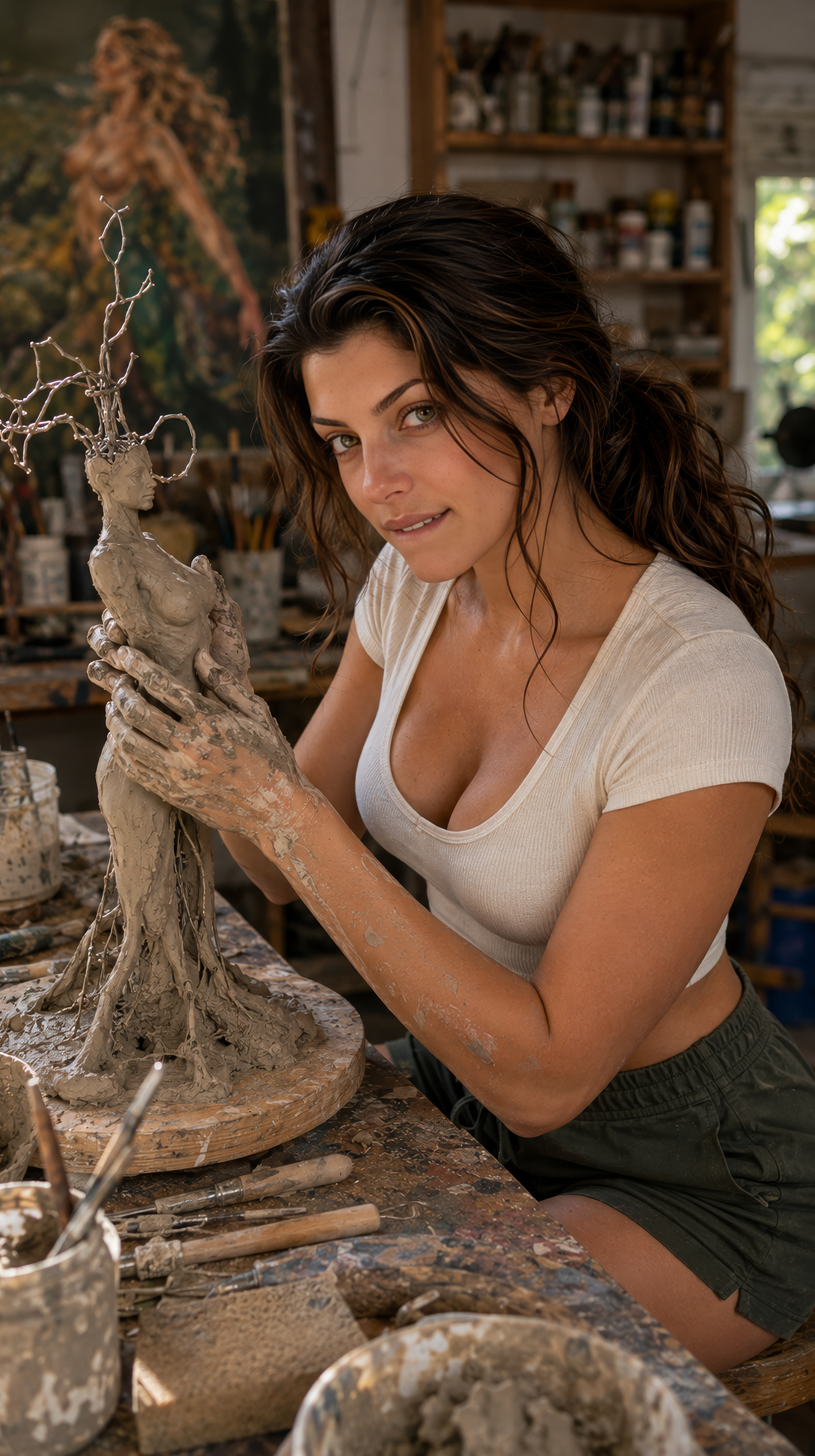
Back at the studio, Jenn changed into shorts and a fitted white shirt, tied her hair into an untidy knot, and turned her attention to a clay figure she had abandoned earlier in the week. It rose from the table like a woman becoming a tree, with roots twisting around the base and branches emerging from her shoulders. Jenn pressed one thumb beneath the figure’s cheekbone, softened the jaw, then scraped away an entire section she had spent hours building. I made the mistake of reacting. “Don’t get attached,” she said. “To the sculpture?” “To anything before I say it’s done.” She worked until clay covered her hands and streaked one forearm, adding and removing so rapidly that progress became impossible to measure. This is the private contradiction at the center of Jenn’s work: she believes deeply in intuition, ritual, myth, and the unseen life within ordinary things, but she trusts almost nothing she makes on the first attempt. She can discuss Artemis, Freyja, or the symbolism of a crow with complete conviction, then spend forty minutes deciding whether a painted line should move half an inch. Around noon, she opened her laptop to review the morning’s photographs. One image held her attention. It showed the creek rushing past a dark root, with a pale flare of light caught near the center. “There,” she said. I saw water, stone, and an accidental reflection. Jenn saw the missing piece of the painting.
She pulled on a blue top, tied an old paint-stained cloth around her waist, and moved the large canvas into the light. For the first several minutes, she did nothing. Then she mixed a gray-green from three colors, rejected it, added rust, rejected that, and finally made something so dark it looked almost black until sunlight touched it. The first stroke crossed part of the figure she had been protecting for weeks. The second buried half her shoulder. Soon Jenn was working quickly, carrying the creek’s reflected light through the roots and breaking the woman’s outline apart until body, bark, and shadow became difficult to separate. “You’re painting her out again,” I said. “No. I’m making her harder to find.” Several hours passed that way. Brushes accumulated in a cloudy jar. Her trousers collected smears of green, umber, and gold. At one point she stepped back, folded her arms, and stared at the canvas with open hostility. “Well?” I asked. “It’s being dramatic.” “The painting?” “Obviously.” She returned with a smaller brush and added a thin line near the center. Suddenly the entire image changed. The woman was still there, but no longer trapped inside the tree. She seemed to be emerging from it, or perhaps returning. Jenn saw me recognize her and smiled. “Five seconds?” “Closer to seven.” “Good.”
By evening, the studio had grown warm and smelled of wet clay, coffee, and oil paint. Jenn stood beside the canvas with her arms crossed, hair escaping from its knot and color streaked across the side of one hand. She looked proud, though she would not use that word. Artists like Jenn often protect themselves with dissatisfaction. If the work is never finished, it can never be judged as the final measure of what they are capable of becoming. That habit had followed her through painting, photography, sculpture, poetry, and nearly every other part of her life. She called herself aspiring even when the room around her proved otherwise. “Is it done?” I asked. Jenn studied the surface for a long moment. “For tonight.” “That isn’t what I asked.” “It’s the only honest answer.” She turned toward me, leaning one shoulder against the canvas with a faint, tired smile. Behind her, the painted woman remained half concealed among the roots. Tomorrow, Jenn might change the light, deepen the shadows, or cover the figure completely. She might decide the clay sculpture needed different hands. She might return to the creek and discover that the tree no longer resembled a woman at all. None of this would mean the day had failed. Jenn’s work is not a march toward completion. It is a long conversation between the thing she intended to make and the thing that appeared while she was paying attention. Nothing in her studio is ever entirely finished. Neither is she. That, she would argue, is what keeps both of them alive.
This gallery was created with the assistance of AI tools.
Want to see more? Create a free account to unlock three additional images, or join All-Access to view the complete gallery.