
Aoibhínn: The Long Way to the Water (25 images)
READ HER STORY
Aoibhínn (29)
Aoibhínn told me to arrive before eight, wear shoes I didn’t mind getting muddy, and bring something I could swim in. She did not tell me where we were going. This is typical of Aoibhínn. She owns an apiary, manages several million temperamental employees, and has developed the calm authority of someone accustomed to giving instructions that are ignored at everybody’s peril. If she tells you not to stand near a particular hive, you move. If she tells you to pack a swimsuit on a perfectly ordinary workday, you pack one and accept that the explanation will arrive when she decides you need it. She was waiting on the porch when I pulled in, freshly showered and still working damp curls through her fingers. Her backpack sat beside her on the steps. She had traded her usual bee jacket and work pants for a fitted green T-shirt, denim shorts, thick socks, and hiking boots. “You’re three minutes late,” she said. “I’m two minutes early.” She smiled. “Not by apiary time.” I asked what apiary time was. “Whatever time I say it is.”
The invitation had come at the end of a brutal stretch of heat. Aoibhínn had spent the week hauling supers, checking water sources, monitoring queens, and trying to keep an inexperienced seasonal helper from putting equipment back in whichever shed happened to be closest. She had canceled two dinners and one afternoon we had loosely planned to spend photographing honey extraction. When she called the night before, she sounded tired but unusually pleased with herself. “I’m stealing tomorrow,” she said. “You can come if you keep up.” Aoibhínn does not take many complete days away from the bees. She claims this is because there is always something that needs doing. I suspect the deeper reason is that she has built a life in which being needed feels dangerously similar to being secure. She is excellent at leaving a hive alone when interference would do more harm than good. She is less skilled at extending that same trust to her own life.
The path began behind the house and disappeared quickly beneath the trees. She knew every fork without checking a map, and at the first one, she took the narrower trail. “That looks less traveled,” I said. “It is.” “Comforting.” Without looking back, she said, “I brought you because bears prefer photographers.” The morning remained cool beneath the canopy. Aoibhínn walked fast, but never so quickly that she left me behind. She pointed out jewelweed, wild mint, and a patch of late-blooming flowers the bees would find if the weather held. Even on her stolen day, she was thinking about forage. She stopped beside one plant, rubbed a leaf between her fingers, and held it out for me to smell. I lifted the camera instead. “You’re impossible,” she said. “You invited a photographer.” “I invited a person who happens to own a camera.” “That distinction has never existed.” She gave me a look that suggested this was my first warning.
A little farther on, I asked how she found the place. Aoibhínn said her father brought her there when she was eleven, after she got stung badly enough to announce that she hated bees and would never go near another one. Rather than lecture her, he packed sandwiches and took her hiking. They spent the afternoon at the falls, and on the way home he told her that being frightened did not obligate her to remain frightened. Two days later, she went back to the hives. “I still hated that particular bee,” she clarified. “She knew what she did.” The trail crossed a creek on a narrow plank bridge that looked older than either of us. Aoibhínn walked across without hesitation. Halfway over, she turned and caught me photographing her. “You know,” she said, “most people look at the water.” I told her most people were not walking behind her. That earned me a raised eyebrow, followed by the smallest, most satisfied smile of the morning. She continued across as though nothing had happened.
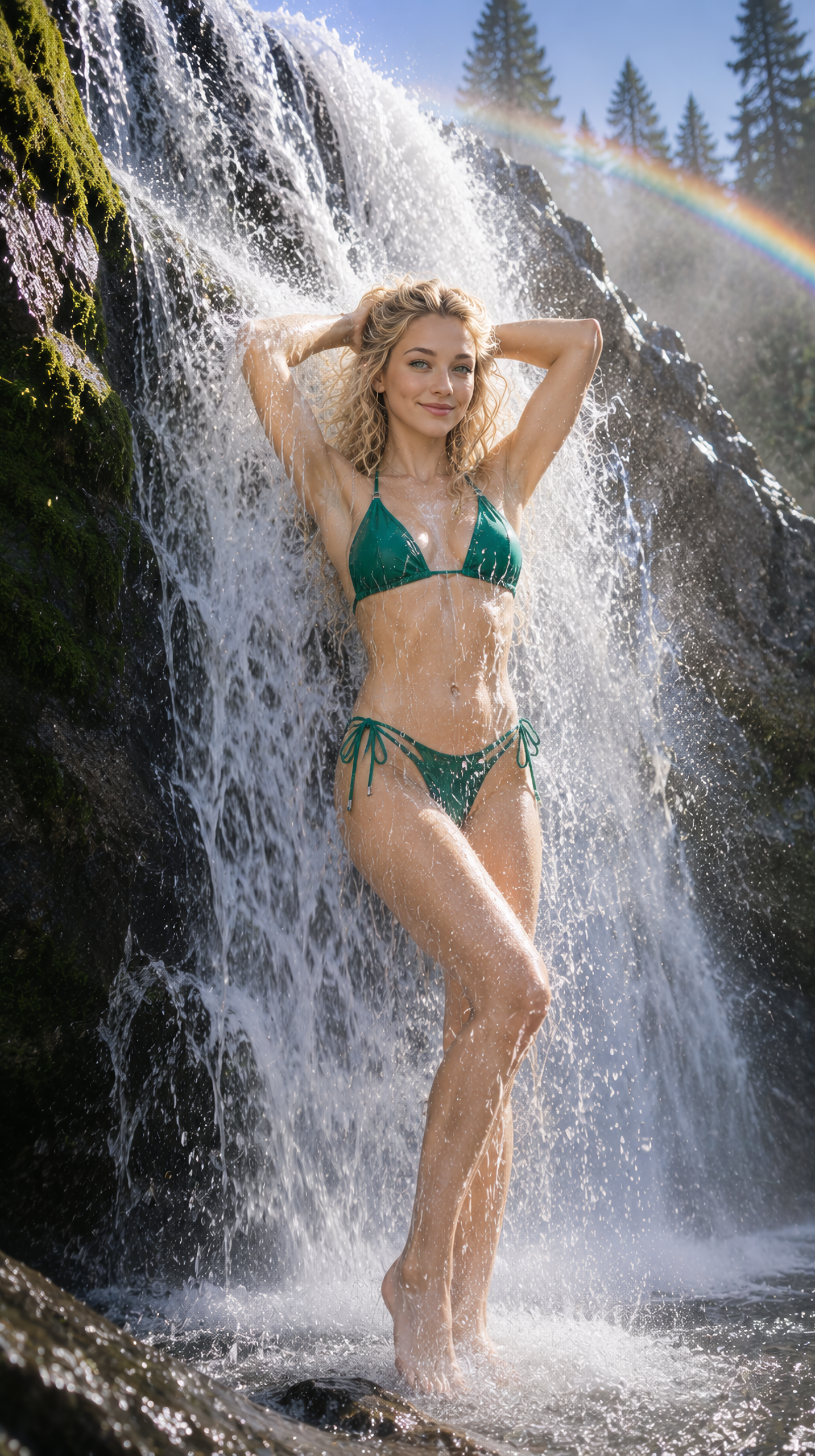
The sound of the waterfall reached us before we could see it. At first, it was a low rush beneath the birds and wind. Then the path descended, the trees opened, and there it was, pouring over a broad shelf of dark stone into a clear pool below. Aoibhínn watched my face rather than the falls. “Worth being three minutes late?” she asked. I admitted it was. We found a flat place near the water and set down our bags. She removed her boots, peeled off her socks, and sat with her feet on the cool rock. For several minutes, she did almost nothing. She tied up her hair. She drank from a metal bottle. She closed her eyes and leaned into the noise. It was the first time I had seen her entirely still. At the apiary, even her pauses have a purpose. She watches entrances, counts activity, checks the sky, or mentally advances to the next task. Here, with the water swallowing every smaller sound, she finally seemed unreachable by whatever waited for her at home. I lowered the camera. Her eyes remained closed when she said, “You can take the picture.” I told her I thought I was supposed to spend time with the person who happened to be in front of my camera. “That distinction has never existed,” she replied.
The swimsuit turned out to be green, because of course it was. Aoibhínn changed behind a stand of trees, although not before accusing me of looking disappointed that she had found sufficient cover. When she returned, she had wrapped her shirt loosely around her shoulders and was testing each rock with the care of someone who knew exactly how quickly a beautiful afternoon could become an embarrassing emergency-room story. She dipped one foot into the pool and recoiled. “That bad?” I asked. “It’s invigorating.” “That means bad.” “It means you’re going in first.” I declined. She tried persuasion, mockery, and finally a solemn appeal to my professional obligation to understand the conditions in which I was photographing her. When none of those worked, she stepped in alone, inhaled sharply, and accused the entire mountain of malice. Thirty seconds later, she was laughing.
The water transformed her. The composed apiary owner who could quiet a nervous visitor with one glance disappeared. She splashed through the shallows, ducked beneath the falling water, and emerged with her curls plastered across her face. She shouted something I could not hear and then repeated it with exaggerated gestures. I assumed she was telling me to join her. She later claimed she had been warning me that the rocks were slippery. I do not believe her. There is an odd intimacy in photographing someone who has forgotten to manage how she is seen. Aoibhínn knows she is beautiful, but she usually treats beauty as incidental, occasionally useful, and slightly embarrassing when mentioned directly. At the waterfall, she began by acknowledging the camera, then teasing it, and finally ceasing to care about it at all. She stood beneath the spray with her hands in her hair and her face lifted toward the sun. She sat in the water and looked up at me with an expression so open that I nearly missed the photograph. She leaned against the mossy rock, caught me staring a second too long, and did not rescue either of us by looking away.
Some outings become dates because two people plan them that way. Others become dates retroactively, after enough small moments have accumulated that pretending otherwise begins to feel dishonest. I am still not certain what Aoibhínn intended. I know she packed lunch for two. I know she brought the swimsuit that matched her eyes when the light caught them. I know she chose a place she had never taken anyone outside her family. I also know she is perfectly capable of doing all three without assigning any romantic meaning whatsoever. Aoibhínn lives in the maddening territory between forthright and unreadable. She will tell you exactly what she thinks about your work, your driving, or your inability to identify a honeybee at six feet. Ask what she feels, and suddenly she becomes fascinated by the weather.
Late in the afternoon, she finally convinced me to put the camera down and enter the water. It was colder than she had admitted. She laughed so hard at my reaction that she nearly slipped, then grabbed my arm and pulled me deeper before I could recover. I reminded her that expensive equipment was sitting unattended on the shore. “Nobody else knows this place,” she said. “You brought me.” “Yes.” It was only one word. She said it lightly, but something in it remained with me.
On the walk home, her wet hair darkened the back of her shirt. The boots and socks went back on, and the green T-shirt covered her swimsuit, but the polished version of Aoibhínn did not entirely return. She was looser, slower, and pleasantly exhausted. She carried her bag over one shoulder and occasionally bumped mine as the path narrowed. At the plank bridge, she stopped in the middle and looked down at the creek. I asked whether she was finally admiring the water. “No,” she said. “I’m giving you a chance to catch up.” Back at the porch, the light had gone honey-gold. She dropped onto the steps beside her backpack and looked as if the entire day had left some private glow beneath her skin. I made one last photograph. “That one better be good,” she said. It was.
Before I left, I asked whether we were ever going back. Aoibhínn leaned against the porch rail and considered the question with exaggerated seriousness. “Maybe,” she said. “If you’re on time.” For the record, I had arrived two minutes early. But I have learned enough about Aoibhínn to understand that this was not really an answer. It was an invitation to ask again.
This gallery was created with the assistance of AI tools.
Want to see more? Create a free account to unlock three additional images, or join All-Access to view the complete gallery.
Lovely
Yes you are just lovly far too young for me but I still like to admire thank you for sharing
Regards Andy p