
America: Summer Owes Her One More Day (25 images)
READ HER STORY
America (24)
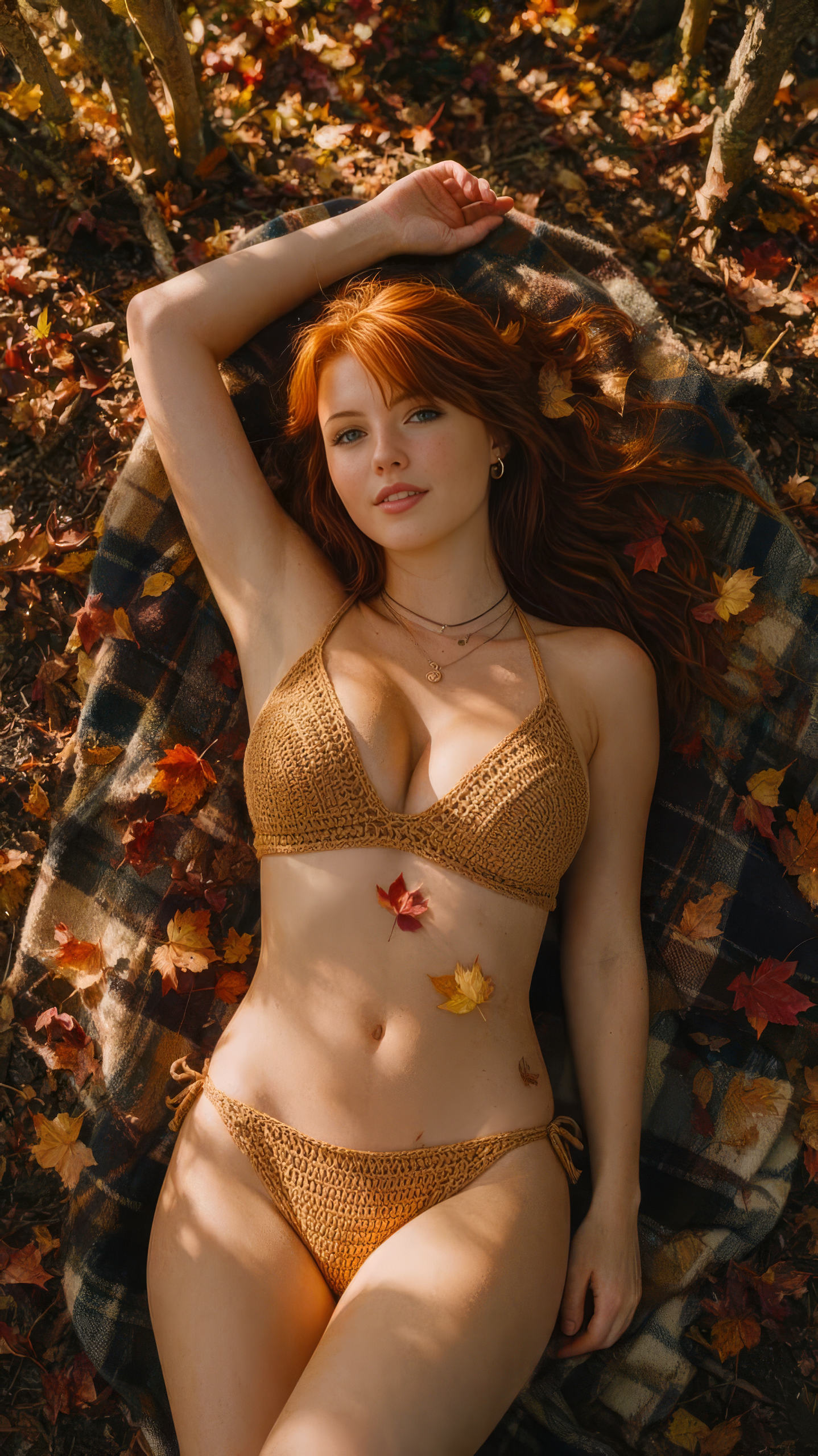
America called it a color study. This was technically true, although it did not explain the bronze crochet bikini, the plaid blanket, or why the color being studied was mostly America. She had been experimenting with a new series of oil paints made from materials gathered around her grandparents’ old wildflower farm, and she wanted to record the forest before autumn surrendered its brighter colors to brown. When I arrived, she was waiting beside the trail with a basket, a camera, and enough confidence to make her outfit seem like the most sensible thing anyone had worn into the woods all week. “It’s seventy-two degrees,” she said before I could ask. “Barely.” “The sun is out.” “Some of it.” America tilted her face toward a narrow shaft of light between the trees. “See? Summer.” The ground was covered in red and copper leaves. “That is overwhelming evidence against you.” She smiled and started down the trail. “Bring the blanket.”
The place she chose was a small clearing above the creek, protected from the wind by hemlocks and warmed by afternoon sun. America spread the blanket over the leaves, removed her sweater, and immediately pretended not to notice me reconsidering every objection I had made along the way. False modesty has never interested her. She knows she is beautiful, knows precisely what bronze does beside her copper-red hair, and sees no particular virtue in making either fact awkward. What keeps that confidence from becoming vanity is her willingness to be ridiculous. She can hold a pose that belongs in a painting, then ruin it by asking whether squirrels understand property law. She can look directly into the camera with enough intensity to make a person forget the cold, then yelp because a leaf slipped beneath her shoulder. “Do not photograph that.” “You looked natural.” “I looked attacked.” She inspected the offending maple leaf, decided its color was useful, and placed it in her basket.
America’s relationship with color began before she understood it could become a vocation. Her grandparents grew wildflowers commercially, and as a child she was allowed to collect bruised petals, fallen blooms, and anything too imperfect to sell. She crushed them in chipped bowls, mixed them with water, and painted on cardboard with mixtures that faded almost as soon as they dried. Her grandfather told her the colors were temporary because flowers were not interested in becoming permanent. America thought that sounded unnecessarily dramatic, but she remembered it. Years later, she began teaching herself how pigments worked, which plants stained, which minerals endured, and why the loveliest natural color often became mud if handled carelessly. She now makes small batches of oil paint from earth, charcoal, stone, and botanical material, recording every experiment in notebooks crowded with measurements, swatches, and impatient remarks. Failed colors receive names such as Regrettable Moss, Dishwater Rose, and Expensive Brown. The successful ones get better treatment. The orange she hoped to develop that afternoon already had a name: Last Warm Day.
We collected fallen leaves from several points along the creek, though America rejected most of them for reasons that became increasingly personal. One was too dull. Another was “trying too hard.” A perfect red maple leaf was dismissed because it looked like something printed on a seasonal tablecloth. She preferred the damaged ones, especially those where yellow, rust, and crimson crowded together around darkened edges. “That’s where the interesting color is,” she said, holding one toward the sun. “Right before it disappears?” “Right before it changes.” America lowered the leaf and looked at it for another moment. For someone whose work depends on preserving color, she is surprisingly unsentimental about transformation. She does not expect flowers to remain open, summers to remain warm, or people to remain exactly who they were when she first loved them. What she resists is failing to notice before they change. Her photographs, paints, pressed petals, and handwritten formulas are less about stopping time than proving she was paying attention while it passed.
Eventually, the work dissolved into the afternoon. The basket sat forgotten beside the blanket. America stretched out beneath the trees, letting scattered leaves settle across her stomach and legs as the breeze moved through the canopy. Every few minutes she lifted one, compared it to her hair, or held it against the bronze fabric as though evaluating a palette. “Still research?” I asked. “Rigorous research.” “What have you learned?” “That this bikini is extremely autumnal.” “Important contribution.” “I expect peer review.” She laughed, then grew quiet as the light shifted lower. The truth arrived without ceremony. She had not brought me there because she urgently needed another orange pigment. She had finished most of the formula days earlier. What she wanted was one last afternoon that did not require a sweater, one last stretch of sunlight warm enough to lie beneath, and someone beside her who would understand that wanting to remember a day was reason enough to make something from it. “You could have just said that,” I told her. America turned onto one elbow and gave me the patient expression she reserves for disappointing questions. “Then you wouldn’t have carried the blanket.”
By the time we packed up, the temperature had fallen and America was finally willing to admit that autumn had won. She pulled the sweater over her shoulders, tucked the basket against one hip, and stopped at the edge of the clearing to look back. The blanket had left a dark rectangle among the leaves, the only evidence that we had occupied the place at all. Tomorrow, the wind would rearrange everything. The creek would continue beneath the trees. The remaining leaves would fall, and Last Warm Day would become a row of small amber tubes on a shelf in her studio. America would use it sparingly, not because the pigment was rare, but because memory always seems more valuable once it becomes finite. Before following me up the trail, she slipped one final copper leaf into the pocket of my jacket. “For reference,” she said. I found it that evening, pressed flat beside my keys. By then I understood that America’s art has never really been about making nature permanent. It is about giving beautiful things somewhere to go after their moment has passed.
This gallery was created with the assistance of AI tools.
Want to see more? Create a free account to unlock three additional images, or join All-Access to view the complete gallery.